Showing posts with label Debate/토론. Show all posts

9.14.2014

Gender, Sex and Politics in Korea: What the Saenuri Party really meant by "Prepared Woman President"

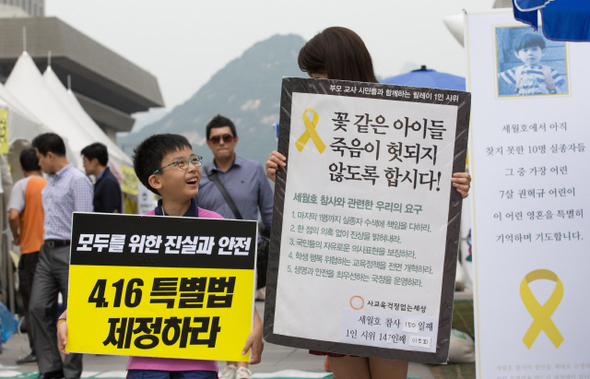
The Park Administration response to the Sewol sinking was absolutely inadequate. Protests and hunger strikes to demand accountability and preventative measures continue to grow five months after over 300 people, mostly students on a field trip, lost their lives.
A family assembles to demand a "safe world for my son."
Apparently some politicians demanding a transparent report on the Presidents' response have been gossiping and speculating on her sex life. Opposition lawmaker Sul Hoon referenced (and dismissed) rumors that President Park was engaging in a "tryst" during a 7 hour period during the tragic Sewol sinking.
President Park participates in mourning the deceased. 
“What did [President Park] do for those seven hours at the Blue House?” Sul asked. “I don’t think it’s true what people are saying about her having a tryst. I think that’s probably not it.”

The resulting political controversy has centered on demands that Sul resign and whether his words were intended to malign the President or to dismiss the rumors. Lost in this discussion is the sexism that the majority party is also leveling at President Park.

While Sul's accounting of the rumors demonstrate a sexist tendency to focus on the unmarried female President's leadership, they also highlight a sense of betrayal and mistrust. The gossip centers on what might have kept the President preoccupied specifically for the 7 hour period during the Sewol sinking.

On the other hand, Saenuri party spokesperson Park Dae-chul's statement blurs President Park's public office and private sex life, and are not limited to a discussion of the Sewol sinking, but extend to a general comment about women's sexuality:

“It’s troubling to think what might happen if there are rumors about ‘the President of the Republic of Korea having a tryst’ going around,” Park added. “The Saenuri Party intends to examine a possible complaint against Sul Hoon to the National Assembly Ethics Committee.”

What might happen?

By emphasizing the "Republic of Korea" in his statement, perhaps spokesman Park calls upon tried and tested fear of Korean womens' bodies and sexuality and the national image. He asks, how might Korea look to other nations?

Is the Saenuri Party particularly sensitive to North Korea state media describing President Park as a "crafty prostitute" in thrall to her "pimp" Barack Obama?" Or is Saenuri still unclear what they meant by the election campaign slogan "Prepared Woman President?" The party cultivates an image of a woman's body and sexuality sacrificed as the "mother of the Korean state" and in control in contrast to the womens' bodies the state aggressively polices and regulates.  

Campaign Slogan: Prepared Woman President


Sources:
Hankyoreh, Opposition lawmaker causes firestorm by referring to president’s “tryst”
Posted on : Sep.13,2014 14:15 KST  http://english.hani.co.kr/arti/english_edition/e_national/655017.html

7.23.2014

Queer Corner: Walking while Queer, "homonationalism" and "pinkwashing"

Someone unknown to me commented on my Facebook profile photo (below) sarcastically referencing "homonationalism" and "pinkwashing" because my photo and text (written in Korean) reads "Let's not stigmatize against LGBTQ people."


I took this photo in December at the launch of Hollaback! Korea. At the time, a group of volunteers made a series of photos to respond to their experiences of street harassment. Our project is (meant to be) inclusive of a wide group of people living in South Korea and a safe space to share experience of street harassment, which may include sexual, racial, homophobic and other verbal, non-verbal and physically harassing behavior in public places. So, we wrote our messages in Korean or English and then edited the photos by adding English or Korean text to overlay the photos or by captioning them so that they could be read and shared in both languages to include our whole community of leaders and supporters.

I took a long time to come out as Bisexual and it is an ongoing process of personal reflection and dialog with trusted friends. When I lived in my home country (US) I only let very few people know and I was very intimidated and lacked the confidence to participate in a supportive community. I have lived in Korea for most of the last 8 years and finally became a part of a community that felt safe among my friends to begin to come out. Since I lived in Korea, several times I have heard in Korean, and a few times in English (the English-speaking population is just smaller) Korean nationals and non-nationals alike target lesbian, gay, transgender, bisexual or gender-role non-conforming people (including me) in public places for street harassment. As a bystander or as the person targeted in those situations, I didn't always speak up. Over time and in the few cases when the comment was directed at me or someone I know, I was more likely to say something or take action.

I made this photo and message because in the classroom, on the street, in a restaurant, in media and in other settings I overhear(d) homophobic comments made in Korean and sometimes in English, but since I live in Korea, I overhear them more often in Korean. Coworkers made homophobic comments in front of and at me, and in a few cases even friends who know that I am Bisexual make homophobic "jokes" directed at me. So, I took the opportunity to respond in ways that I always wish I could/did/would when I hear these statements.

The comment gave me a lot to think about, particularly questioning my position as a person speaking out about homophobia. For example, I consider and critique the U.S. State Department for not evaluating its' own human rights record for far too long while leveraging its critique of other states against them in international affairs. Yet, speaking up for myself and supporting friends is not the same thing as "pinkwashing" and "homonationalism" and as a person anywhere I can add my voice to the discussion and I can respond to the harassment I experience. It does not mean that I am an expert, it does not mean that I am condemning anyone, etc. As I put it before, it simply means "Let's not stigmatize against LGBTQ people."

I am glad to belong to communities of people that share experiences with me and support me, and I am glad to have the opportunity for discussion. I am not going to silently endure homophobia and I will continue to use resources available to me to cope with homophobia, so I am very thankful to have a supportive community that is willing to discuss and hear about experiences of street harassment.

5.14.2014

Attend my talk on Korea's Sex Trafficking Prevention Act, International Norms & Local Legal Rhetoric

I will present a part of my research this Friday afternoon at the International Studies Academic Conference hosted by Yonsei University. The event will run from 1PM to 6PM in New Millenium Hall Room 101. I think I may be the last speaker on the second panel in the flyer below (after 3:30PM presumably). Just FYI, venue is located closer to the Ehwa University back entrance bus stop although you can enjoy the walk through the campus from the Yonsei front gate if you'd like. Hope to see some familiar faces in the audience~


4.05.2014

Does "Get your arse out, mate" Trivialize Sexism, Street Harassment and Survivors?

The Guardian posted “'Get your arse out, mate': we turn the tables on everydaysexism – video” which is getting praise from some, but I am critical of the video and its potential to education the public or build solidarity. You can watch the video at the link above or embedded here:
The Everyday Sexism Project aims to document “experiences of sexism, harassment and assault to show how bad the problem is &create solidarity.” How does The Guardian's Leah Green work to that end by targeting random men in the street?
The idea of “turning the tables on men” grabs attention, for sure, and we’ve seen very successful scripted videos like OppressedMajority that speak volumes about sexism and street harassment without, actually, harassing anyone in the process.


Maybe the Guardian video can even been seen as a platform to make people hear the words that have been used against those contributing at Everyday Sexism Project. Great, but that can be done by other means.

Having watched the video, I cannot get behind the method.

First, and most importantly, NOBODY should be spoken to in ways that make them uncomfortable or are intended to intimidate, humiliate, shame, etc. The Guardian’s Leah Green does not work for Everyday Sexism, but “performed” scenarios inspired by the project on men. Let’s unpack those euphemisms a bit. The Guardian/Leah Green read real accounts of sexism and harassment, and decided to pick random unsuspecting men on the street and “perform” intimidating actions, harassment, and hate speech on them. I have been harassed on the street, I would absolutely abhor seeing my story as a ‘scenario’ ‘performed’ on another human being. 

Yet, the issue is controversial and it is sparking debates, like this: 
Second, the scenarios do not necessarily promote awareness of sexual harassment or street harassment and in turn may even contribute to homophobia or trivializing street harassment survivors. When Leah Green drives by and catcalls out the window, did that teach anyone about the harm? Worse, when Leah Green targets and asks pairs of men if they have "ever made out," the Guardian reporter is making big assumptions the men being asked, such as about their sexuality. 

The segment absolutely overlooks the reality that gay men and trans men and others also suffer street harassment. Further, in the minds of the men being asked, or folks watching the video, the ‘scenario performed on’ the men in the video may either trigger memories of other times they have been targeted for harassment based on their sexual and/or gender identity. Or, rather than promoting awareness about harassment, the question could spark socially heteronormative or homophobic responses, rather than clicking so that they 'get' how this question connects to street harassment of pairs of women. The Guardian comes off as policing masculinity and echoes hate speech that some LGBTQ viewers may have experienced, rather than educating anyone about the Everyday Sexism Project.  

Third, the randomly selected men are not necessarily those that attack women that contribute to the Everyday Sexism Project site. We don’t know anything educational about this project, it’s method, etc. we don't know what was explained to these men that were "performed on" or what opportunity they had to learn from this experience. How does that build solidarity, which is the aim of the Everyday Sexism Project?

Street harassment is painful, and being targeted may have been painful for the men in the video, too. One news outlet titles the image below “Guardianreporterprank_large” and yet the same article commends the ‘undercover reporter’ for maybe raising “some much-needed awareness along the way” through what is labelled a prank. Harassment is not a prank. As Jezebel's Tracie Egan Morrissey points out, "the construction workers didn't like being catcalled at all." Harassment simply shouldn't be trivialized like this: 

The Everyday Sexism Project does powerful work by bringing these stories to light. Taking the project onto the streets and getting people who might not otherwise take time to self-educate is impressive. i would commend the Guardian and Leah Green for doing that. But, I am not sure they achieve public education, or do they potentially damage the reputation of the Everyday Sexism Project by using its' name and coming off as serving up random retribution to?  Careful consideration no doubt went into producing this video, and it is a really notably different video with raw reactions from real people that are not scripted. There will be discussion and reflection, for starters:

How seriously are the media taking this issue? How well does the Guardian understand street harassment? Does the video come off as retribution or as a public education project?


2.03.2014

Seoul Event by Hollaback! Korea: Let's put an end to street harassment in our communities!

Join Hollaback! Korea in Seoul for a discussion about street harassment and how we can end it. Hollaback! Korea supporters will meet Saturday, February 8 from 2-4PM at Ben James coffee shop near Hapjeong station exit 5. Hollaback Site leaders from Seosan and Seoul will be present and welcome all members to participate in the discussion and/or share their stories for support. Hollaback! Korea supporters will strategize how to end street harassment in our communities.

Saturday, February 8, 2014
2:00pm until 4:00pm
Cafe Ben James, Seoul Mapo-Gu Hapjeong-Dong 411-5
See details and RSVP on the Hollaback! Korea Facebook page

Community members of all genders, sexual orientations, race, and national origin are welcome to join Hollaback! Korea. Hollaback! Korea founders and supporters are friends, daughters, students, sisters and brothers, workers, supporters, partners, wives and husbands who are Korean nationals, people of color, adoptees, foreigners, ethnic and overseas Koreans, LGBTQ, young and old, single and multicultural family members of Korean society. we come from Seoul, Gwangju, Busan, Daejeon, Jeju, and Daegu to share these stories. We are building an intersectional space to address street harassment and welcome anyone to join this movement.

This is a map depicting the geographic location of (some of) the stories shared to Hollaback! Korea in the two months since the project launched. See the full map at the Hollaback! Korea website. Pink dots visually depict stories shared by the person targeted for harassment, green dots are stories shared by a bystander who witnessed harassment.


1.27.2014

흑형이란? What is meant by Black (Big) Brother?

흑형이라는 말에 대해 어떻게 생각합니까? 인종차별주의적 태도가 보여합니까? 또한 성적 매력을 부여합니까? What do you think of the term Black (Big) Brother? Does it show a racist attitude? Does it show sexualization?

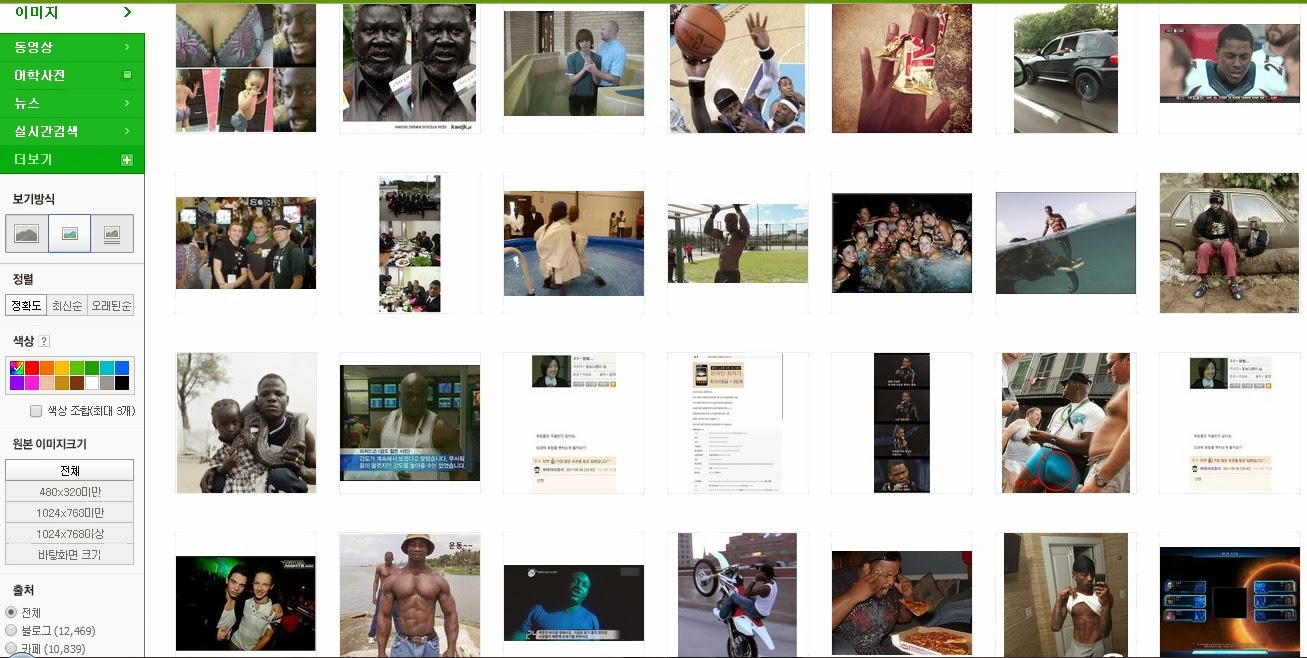
"흑형" 이미지 검색의 결과에 봅시다 Let's take a look at search engine results for the term:
 네이버 Naver:

구글 Google:

"흑누나"의 결과 Black (Big) Sister search term results:

3개월 전에 비공개의 얘기에 봅시다 Let's look at a conversation on Naver from 3 months ago:
Rough Translation: When we use the term "Black (Big? Brother" and thoughtlessly talk down to people with other skin colors, don't you think it can make people of color feel bad and is a wrong thing to do??

Rough Translations:  (top) It isn't talking down. With those words I am going to praise the greatness of Black (Big) Brother and Black (Big) Sister. (middle): It's wrong. But the term is already spread widely. Can't get rid of it People use it a lot ㅜㅜ (bottom with image): The term Black (Big) Brother was made to make people laugh, right? Korea thinks it is so funny so it won't be easy to get rid of. 

네티즌들의 “흑형”이라 붙인 사진에 보면서 인종적 고정 관념에 대해 생각합시다. 이렇게 인해 인종차별주의적 태도가 비판할 수 있다. 예를 들어 억센 팔과 살팍진 몸이 강조하고 이미지의 내용을 평가하면 성관계에 관한 형상화를 많이 본다. When we look at the images that Korean language users attach the term "Black (Big) Brother" to we can think about racist attitudes. In this way we can criticize these attitudes. For example, in the images above we see an emphasis on muscular and sexualized bodies, and that the term is attached to references to sexuality and sexual imagery.

흑형이라는 말에 대해 어떻게 생각합니까? What do you think about the term Black (Big) Brother?

10.25.2013

Event: Seoul, "Don't Do That" Campaign, Saturday Oct. 26, 2-6PM in Hongdae

Seoul Don't Do That 돈두댓 team has a first campaign event in Hongdae at "걷고싶은 거리" near gate no.9 Hongdae subway station, from 2pm to 6pm. There will be a discussion about comfort women. 


10.01.2013

Extended Rebuttal: Inflated Assumption that Sex Workers in Korea Earn “higher than the average Korean”

Here at Korea Gender Café we attempt to present information, data and translations that add to discussion of gender issues in Korean society because we hope to spur discussion. 

Yesterday we submitted a rebuttal piece to koreaBANG’stranslation “Disbelief as Korea is Ranked 108th in Global Gender Equality” that broke down a few methodological flaws in Dr. Kang’s data analysis. Due to space constraints we were unable to respond point-by-point to many of his opinionated assertions. In this post we’d like to zero in on one of the problematic opinions and attitudes he brought into the debate about gender inequality: that the exclusion of the sex industry from workforce participation data inflates the inequality between men and women.

Kang writes,
“Does the misinterpreted data about socioeconomic discrimination in fact imply discrimination against men? 
There are also many problems with the data commonly used to claim sexualdiscrimination against women within Korea. The popular story is that women arebeing discriminated against, as shown by the big gender gap in employment rateand income. However, we need to take a closer look. In fact, the gender gap in employment rate and income is exaggerated in Korea.Among OECD countries, only Korea and Slovenia have made the sex trade completely illegal. MOGEF estimated that there might be 140~270k or a higher number of female sex workers in Korea. Sex workers who earn more than the average worker are exempted from the Korean income statistics while othercountries include them. This partly contributes to the income gap that appearswider on paper than it really is. 
Do they turn a blind eye to this for the sexual discrimination claims?” 
In our submission to koreaBANG we began to respond:
“Dr.Kang points out human rights violations against women in other countries, butwe can point to sexual violence and human rights violations in every country.That is not the purpose of these indices. We agree that it is problematic thatgender inequality indexes do not adequately reflect violence against women orsexual violence. We disagree with Dr. Kang’s outward looking criticism andencourage discussion of sexual violence in Korea.” 
To elaborate, if we want to discuss human rights violations in South Korea, we could pay close attention to the upcoming Constitution Court ruling on the 2004 Act to Prevent Sex Trafficking and Prohibit Prostitution.

First, sex work is omitted from income statistics, as is drug trade, gang/mafia membership and other illegal industries in which we may find both women and men employed. Rather than claiming that its exclusion is an conspiracy to "turn a blind eye" and that it implies "discrimination against men" we find this to be a more persuasive explanation. 

Second, this assumption that sex work earns high incomes likely ignores workplace conditions, rental fees, the lack of pension, income inconsistencies, associated costs, and may obscure all those that profit from the work by taking a portion of fees, etc. 

Third, Dr. Kang does not tell us how many men are employed as sex workers, but some could argue that purchasing the right to sexual use of another’s body in a sex industry with “140~270k or a higher number of female sex workers” in and of itself could be indicative of gender inequality. If the working population is that high while the working population is low in other industries, it suggests there is a segregation of women into a few industries.  

Fourth, others could argue that Dr. Kang ignores men employed in the sex industry or who act as employers of female sex workers. Meanwhile MBN News contributes a stigmatizing tone toward LGBTQ sex workers. 

But what we would really like to argue about -- and the reason we highly anticipate the above mentioned Constitutional Court ruling -- is the persistent social stigmatization of sex workers and violation of sex worker's human rights in police crackdown and incarceration.

First, Dr. Kang never mentions that male clients are only sometimes sent to “John school” while female sex workers pay steep fines and face up to 2 years of mandatory re-education or prison. This is one more example of gender inequality in sentencing. Dr. Kang doesn’t highlight those aspects of policy that actually exist, and he presents no evidence to support his assertions.

Second, sex workers in Korea report serious human rights violations as a consequence of the current legal regime. Sex workers report swallowing condoms because simply walking with a condom is used by the police as evidence against a sex worker. The safety and health implications are rather obvious, but we urge you to read the UNDP report "Sex Work and the Law in Asia and the Pacific: Laws, HIV and human rights in the context of sex work."[1]

Third, heavy stigmatization of females in the sex industry means that even if there were not criminal penalties, gender inequality in sentencing and health perils associated with an aggressive police crackdown, workers are marginalized socially. We highly recommend Katherine Moon’s research for further reading on the history of segregated sex workers near military bases.[2] 

My ongoing research examines the relationship between the 2004 law, court sentencing and gender in Korean society. In the coming months and after publication, I look forward to sharing additional information with our readers. In the meantime, we highly recommend reading posts by sex worker’s rights NGO Giant Girls, 성노동 이론 봇 and Research Project Korea for news. 


For further reading:

Giant Girls, Grant Application, Global Fund for Women, 2010. https://grants.globalfundforwomen.org/GFWSearch/index.php?id=30551

한상희, 건국대 교수, 헌법. “성매매방지법과 여성인권” 민주법학 제30호, 2006.

최우리 기자, "당신이 굳게 믿는 그것이 진리일까," 한겨레,  2012.12.01. http://media.daum.net/society/newsview?newsid=20121201111004557

Cheng, Sealing. “Rethinking “Human Trafficking”: Reflections from South Korea” in Woodrow Wilson International Center for Scholars, MIDDLE EAST PROGRAM & UNITED STATES STUDIES, OCCASIONAL PAPER SERIES, Rethinking Human “Trafficking,” SUMMER 2010.

Godwin, John. "Sex Work and the Law in Asia and the Pacific: Laws, HIV and human rights in the context of sex work." United Nations Development Programme, Oct 2012, p. 112. http://asia-pacific.undp.org/

Kim, Ji Hye. Korea’s New Prostitution Policy: Overcoming Challenges to Effectuate the Legislature’s Intent to Protect Prostitutes from Abuse. Pacific Rim Law & Policy Journal Association, 2007

Moon, Katherine. Military Prostitution and the U.S. Military in Asia, The Asia-Pacific Journal; Japan Focus, Jan 17, 2009.

Weiss, Ayla. Ten Years of Fighting Trafficking: Critiquing the Trafficking in Persons Report through the Case of South Korea, Asian-Pacific Law & Policy Journal [Vol. 13:2, 2012].


[1] Godwin, John. "Sex Work and the Law in Asia and the Pacific: Laws, HIV and human rights in the context of sex work." United Nations Development Programme, Oct 2012, p. 112. http://asia-pacific.undp.org/
[2] Moon, Katherine. Military Prostitution and the U.S. Military in Asia, The Asia-Pacific Journal; Japan Focus, Jan 17, 2009.

9.21.2013

Kpop Rape Culture "Inconvenient Truth" "불편한진실": A Petition to Infinite and Woolim


Angry K-pop Fan writes, 

"Inconvenient Truth" ("불편한진실"), a track performed by Korean male pop group Infinite, is a production embedded with misogynist messages and triggers for gender-based violence. The lyrics promote victim-blaming and gender oppression, while the music video depicts rape culture and undermines its severity. The video is currently being screened in all 31 venues of their world tour "One Great Step."

As much as misogyny in any form should immediately be confronted, there is great concern about the effects this will have on the thousands of fans who will attend these concerts, most of whom are female and in their critical years just before adulthood. As a pop culture product, it stunts efforts against gender inequality and violence by misinforming about sex, interpersonal relationships, and individual liberties. As a production undertaken by Infinite, young men whose voices thousands listen to, it is a betrayal to their obligation not only as role models, but as influential members of society.
The lyrics promote victim-blaming. Reprimanding a woman because of her decision to wear the clothes she chooses justifies that it is her fault she is attracting unwanted attention. This is wrong because it encourages the idea that the reason behind potential violence and abuse is because she is a woman; the acceptance that women will always be violated because they are women; that there is something inherently wrong with being a woman. This is not a healthy message. It steers the blame away from those who are truly responsible: the people who leer at her and the people who violate her. Some examples in reality include this case of an 11-year old Texan girl who was gang-raped and blamed; a 23-year old woman in India who was also gang-raped and continually shamed even after her death. In South Korea, a 29-year old woman who took her own life after being insulted by the court judge; and a 12-year old whose assailants have been excused from certain criminal laws because 'they thought the girl was older.' The ones who commit such horrid acts are sympathized with at the expense of their victim's dignity and self-worth; and the ones truly prosecuted are those who were hurt and abused. This is unfair.

The lyrics promote the assumption that women ought to fear men. The line “men are wolves” (”남자는 모두 늑대야”) is the center of this concern. To accept this as fact is extremely dangerous for a number of reasons. First, this is merely a gender construct and serves to strictly define what being a 'man' really means. Gender constructs buttress power inequalities between sexes because what a man is 'supposed to be' is often a more privileged and advantaged position than a woman. On an individual level, this encourages men to be forward in their approach, as it is an expression of their 'masculinity', even at the expense of a woman's comfort zone. At its extremity, it gives the go-ahead to sexual aggression. Second, men themselves are pressured by definitions of masculinity, thus such characterizations are very reductionist and dismissive of the myriad of ways men choose to express themselves. Third, because it is seen as part of ‘man’s nature’, it is rendered into something that can not be helped. It thus allows for women to be dictated by male-defined standards in how they should behave in society, completely disempowering them from carving out their own individualities. Fourth, it reiterates that the cause of rape and forms of sexual violence and harassment is because, again, a woman is a woman, not because a man violated her. Are women are the ones who need to ‘restrain themselves’ in this situation? This discourages proper prosecution against sexual aggressors, the real instigators of violence and abuse. Finally, as men are reduced to merely their sexual urges, women are desexualized. Women ought to be allowed to express their sexuality (responsibly and consensually) as much as men do; but instead they are discouraged as they are shamed, ridiculed, and automatically thrown under the threat of violence. Men are not told to think they are in danger of the opposite sex, but women are. Men have the agency and a voice that is heard when they fight against harm, but women don’t. This is unfair.

The music video not only depicts patriarchy and rape culture but undermines the severity of it. Rape culture describes our society today: the normalization and perpetuation of violence against women through images and language in advertising, music, movies, TV, books, politics, and personal, everyday life. It is so ubiquitous that we ourselves do not know we allow it to continue through our own experiences, through the words we say and the decisions we make. Portrayals of the Infinite members staring at the woman’s breasts and attempting to look up her dress to the backdrop of lyrics that put the responsibility for these behaviors in the hands of the woman alone - this is rape culture in action. The woman is not communicating any consent whatsoever to being stared at and eventually harassed. “But her clothes?” This communicates the flawed belief that all there is to a woman is her physical beauty, and that she is nothing but a object for men to gaze upon. This arbitrary deprivation of her liberty, the subjugation of her individuality to men, is violence. Furthermore, all of this placed in a humorous light that plays to the affection of Inspirits minimizes the gravity of this issue and impedes them from knowing how to properly identify abuse and violation. Rape culture and patriarchy is the reason why women feel inferior and constantly threatened out in public, and even in their own homes. It is the reason why women experience higher rates of sexual assault than men; why you see on your local news reports of rape incidents in which the victims are women; why a close male friend, acquaintance, or relative are among those who are likely to assault a woman. This is unfair.

We call upon not just the K-pop community but anyone who stands against any form of misogyny to sign this petition to request Infinite, Woollim Entertainment, production and management teams to 1) re-evaluate the concept and execution of "Inconvenient Truth"; 2) consider canceling screenings of "Inconvenient Truth" at upcoming world tour venues and plans for any official release; and 3) acknowledge and understand the reasons behind these requests. We wish not to pin ourselves against Infinite and Woollim Entertainment, but rather work with them as a community in sincere and mutual interest to foster genuine understanding of our plights as young men and women in today's society. Because we are all affected by the implications of a thriving rape culture, we strongly believe that this is a responsibility that requires as collective of an effort as possible.

This may be against one pop culture product, one of which may not be widely known. Regardless, celebrities and figures in entertainment have a voice many of us wish we had. The thousands of fans we are hoping they will feel obligated to enlighten equates to the thousands more these fans will influence at several points in their own lives. Our wish is that this petition be the rock that instigates that powerful ripple effect." 

9.11.2013

How was the Korean Housewife Constructed?

Yesterday I posted a critique of the lazy way we toss around the term Confucian to describe contemporary Korean gender roles. A great comment by a reader prompted me to add additional explanation of what we might overlook when we focus on ‘Confucian’ and ‘traditional’ values. For a more specific discussion of Confucian ideology, I have written about Confucianism and the Choson Dynasty on this blog a few times: Power & Gender in the Early Korean State, Fashion: Regulating the Inner/Outer in Choson Korea, Comparing Marriage in the Middle Ages and Korea’s Choson Dynasty: 서양의 중세 초기와 조선의 결혼비교, and 조선 초기의 파워와 젠더체제. Here I’d like to throw out for our consideration some important alternate explanations of the contemporary construction of family life in Korea. 

I point out internal and external factors that have affected Korea in its modern history to emphasize the breadth of forces at play that are left entirely out of the discussion when we rush to attribute something to Korea's Confucian past. 

Many Confucian social and legal regulations were codified that affected family life, especially between 1300 and 1700. But there is significant doubt as to how deeply Confucian values penetrated into the common social consciousness, as they were largely codes to regulate the elite yangban. The colonial period was immediately predated by a ‘rush to modernize’ to avoid colonization in the late 1800s. On top of that the colonial period through 1945 was a major disruption in so many social structures that we might dub ‘traditional’ so that what we are calling ‘traditional’ today is a complicated reassertion or reconstruction or reclaiming of ‘traditions’ which shouldn’t be presented as a continuous march to the present. There are absolutely some lingering legacies, but we need to add depth to our understanding of Confucianism if we are going to throw it around as an explanation for Korean society today. Worse, I fear that by relying too heavily on the convenience of the Confucian explanation, we overlook more important influences on family life.

For example, in talking about housewives, we should not have this conversation without discussing the following major influences in recent history:

THE FIRST being the urbanization drive under Park Chung Hee, which disrupted ‘traditional’ family life in incredibly transformative ways. In Confucian and even in colonial period Korea family structures were generally larger multi-generational networks and geographically close. Pre-industrialization in Korea (which was only partially ushered in during the colonial period) families were more agrarian and family roles quite different from today. Here on the blog we have discussed the Theory of Compressed Modernization, which describes how Korea underwent rapid transformation in under 60 years that Europe process over the course of 200 years. When Park Chung Hee pushed urban industrialization, state policy transformed the family. Where once a network of women and men cooperated in a large family unit, now a mother was mobilized to prepare her husband, children (male and female) for economic competition in the city and factory. When the state didn’t have the foresight to prepare some social safety nets for the elderly left in the countryside, it was more convenient to criticize women for abandoning their ‘traditional’ roles than acknowledge how the state had reconstructed family life without preparing to care for the old. Newspapers in the 1970s criticize women (similar critiques emerged of the ‘New Woman’ in the colonial period). This transformation under Park Chung Hee sounds a lot more like the housewife Harper describes than anything in Confucian texts or dating back to Choson. There are absolutely some lingering legacies of Confucian ideology in Korean society, but these are redefined and deployed by contemporary actors.

SECOND, we can’t overlook the reality that European and North American societies made basically the same general decisions about gendered division of labor amidst industrialization. This is another reason to doubt a uniquely Korean tradition that created the housewife.

THIRD, I think the intensification of competition for rapid modernization probably has had the most direct and adverse affects on human rights conditions in Korean society. This means that in thinking about how to address these harms, we are distracting ourselves with ‘Confucian tradition’ when maybe we should instead be thinking about the hegemonic way Samsung corporate structure harms family life in contemporary Korea, or the continued mobilization of the people by government to make steep sacrifices with inadequate social safety nets. Looking too distantly and too ‘culturally’ into Korea’s past obscures the political and economic changes we can demand today that are changing patterns of inequality. We need only look to the incredibly important influence of the IMF crisis in the 1990s, which reversed a lot of trends in Korean society toward gender equality. Not unlike recessions in other regions, women pay a heavier price for economic slowdown, and that isn’t unique to Korea. It is a failure of most societies to adequately engage women productively in society in ways that respect their human rights. For more discussion of Compressed Modernization Theory on this blog, please see Compressed Modernization for Gender Studies 압축적 근대성와 젠더 and 압축적 근대성 이론 Compressed Modernization Theory for Korean Studies.

TO wrap this up, I think it is really skipping quite a few steps to simplistically say that the housewife in contemporary Korea is a Confucian tradition unique to Korea. It just isn’t that linear. Better to understand a variety of factors and locate the influences that have the most detrimental effects on women’s human rights.

--
Lastly, I've written a few times about the problem of associating violence against women as 'unique' to certain societies. Some of these earlier posts could definitely use some revisiting, revising or renewed debate. In the following posts I emphasize that HOW we talk about violence against women is very important:

Sexual Violence as a Migrating Woman, Re: India Story You Never Wanted to Hear

Yoon is NOT in a 'sex scandal'

Buzzfeed! Fearing rape is not a “Unique side effect of being an Indian girl”

Single Moms & Korean Fertility Policy 싱글맘와 한국의의 가족계획

~녀 뉴스 or Nyo News, the Female Files

MBC 응답 Responses to MBC's The Shocking Reality About Relationships With Foreigners

Rape and Sex Offender Registry in Korea 성폭행와 성범죄자알림

9.09.2013

Solidarity is for White Women in Korea, too. Re: The Fear of Becoming a Housewife

Let’s talk about how so many writers lazily toss around Confucianism and its’ impact on gender roles in Korean society. Let’s pursue alternate, more complicated and more rigorous discussions of Korean society. At stake is not only intellectual rigor, but the pursuit of mutual understanding that can only be achieved when we stop recklessly dismissing cultures when we could be building solidarity. Although there are many pieces in which we encounter the assertion that Korean gender roles are Confucian, I am going to point to a piece by Megan Harper who recently contributed “THE FEAR OF BECOMING A HOUSEWIFE” to Groove Magazine.

Harper writes (emphasis mine),  
“This year, I married a Korean man. He isn’t “Korean-Korean,” which is our code to mean he is comfortable with the ways of life outside of the peninsula.”
"He understands the limits that Confucianism places on women and tries his hardest to understand my expectations of equality."
"I have met many women with advanced degrees in subjects such as Russian literature, Chinese and graphic design who abandon all career goals once they marry. Or maybe it is because many of the young women I work with consider university to be simply a way to meet a wealthy man and become his housewife."  
"What I was not prepared for, though, was the depth of his parents’ gender roles, my feelings toward their way of life and the effect these things would have on my ability to relate to his parents. It is hard to hide my discomfort when I see my mother-in-law prepare a beautiful dinner that her husband has half eaten before she even has a chance to sit down. I cannot understand why she tolerates this lack of family assistance. Although I am embarrassed by my own narrow-mindedness, this type of event, and my perception of her, makes it very difficult for me to relate to her; my own refusal to take on the “housewife” role has made it hard for me to embrace this woman.
I know that traditional gender roles continue to exist in my own culture, but they feel much more limiting in Korea. Perhaps it is because, as an outsider, they are easier to see." 
When I hear similar comments from Americans (ex. I frequently hear something like "At Chuseok all the men drank and all the women cooked and cleaned, can you believe how sexist Korea is?") I add this bit of analysis: Perhaps it is easier to see Korean women this way because I was raised in a culture that stereotypes Asian women, I was raised falsely to think that my culture has the 'most' gender equality, I was raised in a culture willfully blind its own exploitation of Asian women. It is important for people from my culture to unlearn some of the racism and nationalism we were raised with. .

TO SUMMARIZE the piece, the author (not Korean) discusses a process of negotiating gender role expectations with her (Korean, but not so-called “Korean-Korean) husband. The author also reflects on her own attitude toward her (I guess the author would say, “Korean-Korean”) “traditional” mother-in-law’s gender role and Korean women's sacrifices for family. The piece emphasizes a link between “traditional Korean” (Confucian) culture and gender role expectations, contrasting this with only the briefest of references to her own culture. Her unnamed and largely un-examined culture is not subjected to the same lens. The key words used to describe women and her home culture include: equality, independent, respectable, equalized gender roles, etc. 

Honestly, at first I wanted to get behind the effort the author says she is putting into understanding her mother-in-law, but ultimately found the piece somewhat offensive and the cultural explanations kind of lazy and stereotypical. This is no doubt because SO MUCH of our dialog in English-language literature talks about Korea in this way. I struggle to find English newspapers abroad that don’t talk about Confucianism in every piece about Korea, even when it is about a plane crash >.< Even many Korean friends and classmates will emphasize Confucianism instead of other explanations possibly because it has become a quick and easy way to describe and emphasize perceived differences. Back to what the Grand Narrative dubbed 
the author concludes,
"I hope to share with others my unexpected limit in understanding that arises from my own gender role expectations. Regardless of my mother-in-law’s reasoning, it is futile for me to judge her. I will strive to respect her for the sacrifices she has made while using my own life to demonstrate equalized gender roles."
FIRST and FOREMOST I have to critique the way that the author positions her life as a demonstration of equalized gender roles to her mother-in-law. Despite prior reflections on trying to be open-minded, the piece asserts a instructive superiority of a not 'Korean-Korean' life and mindset over a 'Korean-Korean' life and mindset. The author also leaves out a lot of incredibly important context about these so-called 'equalized gender roles.' This discussion may also reveal our blindness to our own privileges and complicity in exploitation that we externalize and blame on others and other cultures.

LET’S START with how not unique to Korea it is to have a mother-in-law that does the majority of the housework or who has ‘traditional’ views about gender, motherhood or being a wife. Personal disclosure, I recently married an American man and my mother-in-law and I have some quite different and some shared views about culture and gender roles even though our citizenship is the same. Before my partner, I once lived with a long-term with a partner and his mother who migrated to the US from Mexico. My partner’s mother and I also had some different and some shared attitudes about culture and gender roles despite not having the same citizenship. I lived in a homestay in Korea for over a year, and once again similar and different ideas about gender roles. My mom did all the cooking and cleaning except for once a week when my father typically ordered in food and dumped trash. Guess what, if you are raised by a single mom (as I later was, and as my cousins were), who is it that is doing the cooking and cleaning? I bet it is usually still mom and not dad. Thinking about the men in my life growing up, I have an uncle who migrated from Greece to the U.S. Another uncle migrated from Iraq. During all of the Catholic, Jewish, Orthodox Catholic, and Islamic holidays, also during the Chuseoks, Thanksgivings, the quinceañeras, even during the national holidays and other special occasions that I have attended and participated in, women did the cooking, the cleaning, the care and love work. 

NEXT, the author is worried about becoming a Korean housewife and wants to keep working. I would like to see a follow-up reflection by the author on how she engages her husband, husband’s boss, her boss and most importantly her mother-in-law or possibly a nanny in a few years when she wants to keep working and is struggling to find daycare. Will grandma be more relatable or her gender role more appreciated when the time comes to make that decision? Though, I honestly really hope we don’t need that reflection because I hope SOME administration will start taking social welfare policy seriously.  

I sense a rebuttal: So you say American women and European women's workforce participation has surged? Let's break that down a bit, too. Women in my family, a grandma or an aunt not working outside the home, absolutely took on the care work while both or a single parent were working. Let's look at broader social trends. At the same time that women's workforce participation in the US and Europe has surged, simultaneously world migration trends reflect a major shift toward a majority of migrants being female? In origin societies we see complex family decisions over whether or not to send daughters and wives abroad for migration to destination states in Europe and the Americas. Migration patterns all over the world are pushed by gender roles that haven’t changed THAT much in the ‘West’ and by economic competition that compels all sorts of changes in societies. What work are female migrant laborers doing? Largely care, reproductive and sexual labor. How many affluent households in the U.S, in Western Europe, in Korea and Japan are replacing middle and upper-class family housewives with migrant or increasingly 'competitive market-solution' labor like fast food, boutique daycare, dry cleaners, etc.? I love all the fancy jargon we (myself included!) use to glorify and add scientific weigh to our own cultural solutions while we dismiss other countries for having ‘traditional’ or in this case ‘Confucian’ solutions.

FINALLY, let’s get to Confucianism. I don't think the author understands Confucianism and how it has transformed and been transformed by Korean society. Nor do I think the author tries to think of other explanations besides Confucianism. The Confucian card is over played and we are missing out on better explanations. Too often, writers use Confucianism as a neat and tidy quick way to dismiss something in Korea as essentially 'pre-modern' while simultaneously failing to make any further inquiry into Korea's modern history and society.

In particular, let’s drop the 'backward Confucian Korea' trope and seek more nuanced explanations. Frankly, in the context of this piece, the Confucian trope pretends that all issues in Korean society today are 'pre-modern' and tied to some ingrained sexist cultural/religious though pattern. I think that bit of explanation is tidily left off because that would implicate modern structures all over the world and also require consideration of Korea's colonial and occupied recent history. In turn, this ignores the role of government intrusion into family life in modern Korean history, and especially the mobilization of family and housewife for a decidedly neo-liberal international market. Was Park Chung Hee acting in accordance with Confucianism or aligning policy with the cold war and international markets?

Furthermore, is that mobilization of women and family an isolated experience in Korea? No. Even seen a poster of Rosie the Riveter? Or a war-time volunteer nurse? Or a Red Cross volunteer knitting socks? Oh, those examples are too distant and you don’t want to compare US and Europe in WWII to post-colonial and Korean War recover era Korean workforce mobilization? What happens to American and European women during recession? Hours and benefits cut to keep “more people at work” rather than all-out cutting jobs? Funny how we keep reading that women and people of color in America are disproportionately losing benefits and having hours cut.

Like the Americas and Europe, Korea has also had mobilization of women for home labor, for labor in manufacturing and unpaid care labor for troops, students, husbands and sons, and so has every other country ever. How can we use Confucianism as the sole explanation for anything in Korean society while ignoring the influences of religion (Protestantism anyone?), Japanese colonial state education of women for low pay low skilled labor (Thank you NEW RIGHT textbook revisionism, what a TRIUMPH that was for gender equality), US-ROK economic ties and international markets that mobilized men abroad to wars and oil fields, rapid modernization pressures and lacking social safety nets. I don't have a full explanation, but lazily tossing around "Confucianism" isn't good enough and we need to start a better dialog about societies. More urgently, we need to keep promoting less offensive conversations about Korean women, men and their families. Not just on blogs but also in news media and academia, too.   

Maybe in Korean society we need a dose of something similar to what intersectional feminism and the recent #SolidarityIsForWhiteWomen dialog represent in the US. As feminists, let’s stop dismissing other women’s culture and start listening. This dialog would be a vital precondition for really working together to face inequality and other challenges we face in our societies.


I’m guilty of some laziness too, that’s why I need to keep listening, studying, reflecting and looking for other viewpoints. Re-reading some of my posts on this blog, I realize that in my living and studying process I’ve changed my views quite a lot over the past 14 months of blogging about gender and Korean society. Thank you to readers and critics and friends for your dialog. Since I know I am also in a privileged space where I can access information as my full-time occupation, to spread some of that around, here is a short reading list that inspires much of what I have written here:

Chang, KS and MY Song. 2010. “The stranded individualizer under compressed modernity: South Korean women in individualization without individualism” The British Journal of Sociology 61(3): 539-564.

Cheng, Sealing. "Sexual Protection, Citizenship and Nationhood: Prostituted Women and Migrant Wives in South Korea," Journal of Ethnic and Migration Studies. Vol. 37, No. 10, Dec. 2011.

Cho, Uhn, “The Encroachment of Globalization into Intimate Life: The Flexible Korean Family in “Economic Crisis”” Korea Journal 45(3), 2005.

Cho, Joo-hyun. “Neoliberal Governmentality at Work: Post-IMF Korean Society and the Construction of Neo-liberal Women” Korea Journal 49(3): 2009.

Nelson, Laura, “Measured Excess: Status, Gender, and Consumer Nationalism in South Korea,” 2000.

Parreñas, Rhacel Salazar. Servants of Globalization: Women, Migration, and Domestic Work, published by Stanford University Press, 2001.

Kim, Hyun Mee. "The State and Migrant Women: Diverging Hopes in the Making of “Multicultural Families” in Contemporary Korea" in Korea Journal, Winter 2007.

Yi, Eunhee Kim, “’Home is a Place to Rest’: Constructing the Meaning of Work, Family and Gender in the Korean Middle Class,” Korea Journal 38(2), 1998.