Showing posts with label opinion/오피니언. Show all posts

9.14.2014

Gender, Sex and Politics in Korea: What the Saenuri Party really meant by "Prepared Woman President"

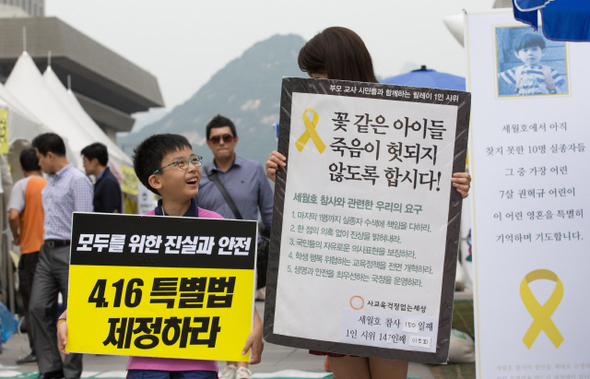
The Park Administration response to the Sewol sinking was absolutely inadequate. Protests and hunger strikes to demand accountability and preventative measures continue to grow five months after over 300 people, mostly students on a field trip, lost their lives.
A family assembles to demand a "safe world for my son."
Apparently some politicians demanding a transparent report on the Presidents' response have been gossiping and speculating on her sex life. Opposition lawmaker Sul Hoon referenced (and dismissed) rumors that President Park was engaging in a "tryst" during a 7 hour period during the tragic Sewol sinking.
President Park participates in mourning the deceased. 
“What did [President Park] do for those seven hours at the Blue House?” Sul asked. “I don’t think it’s true what people are saying about her having a tryst. I think that’s probably not it.”

The resulting political controversy has centered on demands that Sul resign and whether his words were intended to malign the President or to dismiss the rumors. Lost in this discussion is the sexism that the majority party is also leveling at President Park.

While Sul's accounting of the rumors demonstrate a sexist tendency to focus on the unmarried female President's leadership, they also highlight a sense of betrayal and mistrust. The gossip centers on what might have kept the President preoccupied specifically for the 7 hour period during the Sewol sinking.

On the other hand, Saenuri party spokesperson Park Dae-chul's statement blurs President Park's public office and private sex life, and are not limited to a discussion of the Sewol sinking, but extend to a general comment about women's sexuality:

“It’s troubling to think what might happen if there are rumors about ‘the President of the Republic of Korea having a tryst’ going around,” Park added. “The Saenuri Party intends to examine a possible complaint against Sul Hoon to the National Assembly Ethics Committee.”

What might happen?

By emphasizing the "Republic of Korea" in his statement, perhaps spokesman Park calls upon tried and tested fear of Korean womens' bodies and sexuality and the national image. He asks, how might Korea look to other nations?

Is the Saenuri Party particularly sensitive to North Korea state media describing President Park as a "crafty prostitute" in thrall to her "pimp" Barack Obama?" Or is Saenuri still unclear what they meant by the election campaign slogan "Prepared Woman President?" The party cultivates an image of a woman's body and sexuality sacrificed as the "mother of the Korean state" and in control in contrast to the womens' bodies the state aggressively polices and regulates.  

Campaign Slogan: Prepared Woman President


Sources:
Hankyoreh, Opposition lawmaker causes firestorm by referring to president’s “tryst”
Posted on : Sep.13,2014 14:15 KST  http://english.hani.co.kr/arti/english_edition/e_national/655017.html

9.06.2014

Pop Culture & Gender: Why Baekma?

Guest post by the band Baekma. KGC readers will know by now that I (Chelle) dislike the term Baekma,so I asked the band why they choose it and how they are using it to call attention to gender issues. Find the band on Facebook and listen to their music here

“What’s the name of your band?”  “Baekma.”  “Huh?” “BAEKMA!” 

The name we chose for our band warrants many types of responses.  Foreigners or Korean women must think we like galloping beautiful ponies when we explain the definition. Korean men, however, are left with looks of surprise, shock or comical amusement. These men almost always ask, “Do you know what that means?” as if we weren’t privy to their dirty little secret. Well, we do know what it means and we chose it to shock you, on purpose.

The phrase literally translates to ‘white horse’ taken from Chinese.  A Korean male friend informed me that it began a few decades ago as slang used to refer to the only Western women one could find in Korea, Russian prostitutes working the streets of Itaewon.  It evolved over time to mean any Western woman.  If this is the true origin, it’s no wonder that the word implies sex. Mumbled drunkenly among chingus when a wayguk woman passes them on the street at 4 am, or mentioned when a buddy returns from a vacation abroad, this word is tossed around between Korean men with curiosity: “What’s it like to ride the Baekma?” “Did you ride a Baekma on your trip to Europe?”

After Korean men realize we are aware of the negative connotations behind our name, we get responses like, “Why would you name your band that?” or “That’s so sexual!”
First off, I suppose we WANTED to be controversial and expose the stereotypes surrounding Western women. We started as an all-girl Western band, coming together after mixed experiences playing in bands with all boys. Besides feeling like we had more to prove since we were women in the music scene, we wanted to confront and challenge the idea that Western women are easy to get into bed or are only valuable in a sexual way. Just because a woman is in charge of her own sexuality, doesn’t mean she is promiscuous or dirty. Just because she has a nice set of legs or arms, doesn’t mean her wish in life is to use them to please a man. Just because she prefers to decide how she wants to look or act regardless of how a man says she should, doesn’t mean she is less beautiful. It’s easy to get disheartened in Korea if you do not fall into the limited impossible standard of beauty. We believe women shouldn’t be seen as less talented, less driven, less intelligent, or weaker than a man because cowardly men prefer it. It’s easy to get disheartened in Korea if you are not used to or do not fall into the very narrow ideal of feminine beauty within this culture. This standard is impossible to uphold without expensive treatments, surgery and/or hours wasted on grooming. Also, many men seem to be holding on the antiquated idea that women’s role in life is to serve them. Sam Hammington, whether speaking from his own mind, or instructed by a producer, said on the Global episode of Happy Together in 2013 that he married a Korean woman because “Korean women are really good to men,” implying that Western women are NOT because they “have their own lives”, “are never affectionate” and “never act cute”. In one quick comment, he reduced Korean women’s existence and demonized the concept of independent women in charge of their own lives. We know that Korean women are tired of their stereotypes and expectations as much as we are. We channeled our frustrations of living in this hyper-sexualized and misogynist society into our music.

There hasn’t really been anyone providing a voice for the foreign women community within the indie rock scene in Seoul. We feel we have a unique perspective on gender issues as we compare progress here and abroad. We hope our voices can support the movement towards gender equality and freedom of women to choose what they want to become not only in Korea, but also worldwide.

So we are BaekMas. We are not offended by that word. We are Baekmas. We act and dress how we want. We say what we feel and believe in. We write songs about the shitty stuff we see happening to people around us that’s sometimes based on gender. We sing about how we want the world to be. We will probably disagree with you. We may even piss you off. We may or may not sleep with you. But we will definitely make sweet love to your ear holes with our synth dance pop rock.

Find information on Baekma's upcoming podcast here.


7.23.2014

Queer Corner: Walking while Queer, "homonationalism" and "pinkwashing"

Someone unknown to me commented on my Facebook profile photo (below) sarcastically referencing "homonationalism" and "pinkwashing" because my photo and text (written in Korean) reads "Let's not stigmatize against LGBTQ people."


I took this photo in December at the launch of Hollaback! Korea. At the time, a group of volunteers made a series of photos to respond to their experiences of street harassment. Our project is (meant to be) inclusive of a wide group of people living in South Korea and a safe space to share experience of street harassment, which may include sexual, racial, homophobic and other verbal, non-verbal and physically harassing behavior in public places. So, we wrote our messages in Korean or English and then edited the photos by adding English or Korean text to overlay the photos or by captioning them so that they could be read and shared in both languages to include our whole community of leaders and supporters.

I took a long time to come out as Bisexual and it is an ongoing process of personal reflection and dialog with trusted friends. When I lived in my home country (US) I only let very few people know and I was very intimidated and lacked the confidence to participate in a supportive community. I have lived in Korea for most of the last 8 years and finally became a part of a community that felt safe among my friends to begin to come out. Since I lived in Korea, several times I have heard in Korean, and a few times in English (the English-speaking population is just smaller) Korean nationals and non-nationals alike target lesbian, gay, transgender, bisexual or gender-role non-conforming people (including me) in public places for street harassment. As a bystander or as the person targeted in those situations, I didn't always speak up. Over time and in the few cases when the comment was directed at me or someone I know, I was more likely to say something or take action.

I made this photo and message because in the classroom, on the street, in a restaurant, in media and in other settings I overhear(d) homophobic comments made in Korean and sometimes in English, but since I live in Korea, I overhear them more often in Korean. Coworkers made homophobic comments in front of and at me, and in a few cases even friends who know that I am Bisexual make homophobic "jokes" directed at me. So, I took the opportunity to respond in ways that I always wish I could/did/would when I hear these statements.

The comment gave me a lot to think about, particularly questioning my position as a person speaking out about homophobia. For example, I consider and critique the U.S. State Department for not evaluating its' own human rights record for far too long while leveraging its critique of other states against them in international affairs. Yet, speaking up for myself and supporting friends is not the same thing as "pinkwashing" and "homonationalism" and as a person anywhere I can add my voice to the discussion and I can respond to the harassment I experience. It does not mean that I am an expert, it does not mean that I am condemning anyone, etc. As I put it before, it simply means "Let's not stigmatize against LGBTQ people."

I am glad to belong to communities of people that share experiences with me and support me, and I am glad to have the opportunity for discussion. I am not going to silently endure homophobia and I will continue to use resources available to me to cope with homophobia, so I am very thankful to have a supportive community that is willing to discuss and hear about experiences of street harassment.

5.14.2014

Attend my talk on Korea's Sex Trafficking Prevention Act, International Norms & Local Legal Rhetoric

I will present a part of my research this Friday afternoon at the International Studies Academic Conference hosted by Yonsei University. The event will run from 1PM to 6PM in New Millenium Hall Room 101. I think I may be the last speaker on the second panel in the flyer below (after 3:30PM presumably). Just FYI, venue is located closer to the Ehwa University back entrance bus stop although you can enjoy the walk through the campus from the Yonsei front gate if you'd like. Hope to see some familiar faces in the audience~


1.27.2014

흑형이란? What is meant by Black (Big) Brother?

흑형이라는 말에 대해 어떻게 생각합니까? 인종차별주의적 태도가 보여합니까? 또한 성적 매력을 부여합니까? What do you think of the term Black (Big) Brother? Does it show a racist attitude? Does it show sexualization?

"흑형" 이미지 검색의 결과에 봅시다 Let's take a look at search engine results for the term:
 네이버 Naver:

구글 Google:

"흑누나"의 결과 Black (Big) Sister search term results:

3개월 전에 비공개의 얘기에 봅시다 Let's look at a conversation on Naver from 3 months ago:
Rough Translation: When we use the term "Black (Big? Brother" and thoughtlessly talk down to people with other skin colors, don't you think it can make people of color feel bad and is a wrong thing to do??

Rough Translations:  (top) It isn't talking down. With those words I am going to praise the greatness of Black (Big) Brother and Black (Big) Sister. (middle): It's wrong. But the term is already spread widely. Can't get rid of it People use it a lot ㅜㅜ (bottom with image): The term Black (Big) Brother was made to make people laugh, right? Korea thinks it is so funny so it won't be easy to get rid of. 

네티즌들의 “흑형”이라 붙인 사진에 보면서 인종적 고정 관념에 대해 생각합시다. 이렇게 인해 인종차별주의적 태도가 비판할 수 있다. 예를 들어 억센 팔과 살팍진 몸이 강조하고 이미지의 내용을 평가하면 성관계에 관한 형상화를 많이 본다. When we look at the images that Korean language users attach the term "Black (Big) Brother" to we can think about racist attitudes. In this way we can criticize these attitudes. For example, in the images above we see an emphasis on muscular and sexualized bodies, and that the term is attached to references to sexuality and sexual imagery.

흑형이라는 말에 대해 어떻게 생각합니까? What do you think about the term Black (Big) Brother?

1.25.2014

Street Harassment in Korea

A little over six weeks since launching Hollaback! Korea I have already read about 20 stories from members of our community. I have also seen hundreds of people step up to join our project to end street harassment. At our events and during interviews, a number of people who have not written their stories and shared to the site have also discussed the issue with me.

An audience member at our Bystander Intervention Workshop
I am frequently asked, "What is Hollaback?"

Hollaback is an international movement to end street harassment that is active in 24 countries and over 71 cities in 10 languages. By street harassment, we refer to sexist, racist, transphobic, homophobic, ableist, sizeist and/or classist harassment that often targets women, LGBTQ and transgender community members. This harassment takes place in public places like parks, the subway, on the street or in a shop. Street harassment can be intimidating behavior intended to make the target uncomfortable or scared. It can be verbal, physical, gestures or noises, and other forms of intimidating behavior.

"How was Hollaback! Korea founded?"

We are organizing this project all over Korea, but particularly in Seoul, Gwangju, Jeju, Seosan, Daejeon and Daegu. I started to recruit founding team members last July and we all participated in a 3 month online training course and supported by the iHollaback international team so that we could prepare for the launch in early December. We had a lot of hard work like translating the website and mobile app into English, planning 5 launch events in Seoul, Gwangju and Jeju, moderating and growing our social media presence on Facebook and Twitter, and doing media and press outreach. I am really grateful to our team for their dedication and to our community for their warm welcome.

"How does Hollaback! address street harassment?"

Hollaback! has empowered people in over 70 cities and 24 countries internationally to respond to street harassment through a smartphone or web application. Users are encouraged to speak up when they see harassment by quickly documenting it in a short post (photo optional) and sharing it to a publicly viewable map. Anyone browsing the stories on the Hollaback! maps immediately understands 3 things:

1) If you’ve been harassed, you’re not alone,
2) Street harassment is used to exert control over others by making them feel scared or uncomfortable. It is much more than individuals just acting inappropriately.
3) There are street harassment “hotspots” in most cities often centered around high pedestrian traffic areas.
Hollaback! provides comfort to those harassed, and proof that street harassment is a serious problem warranting a serious response from policy makers.

"Is Hollaback! Korea different from other sites because of domestic law?"  

First, it is important to note that our project is about support and social awareness. We are primarily focused on supporting those targeted for street harassment and to promoting public outreach to stop harassers. We believe that what specifically counts as street harassment is determined by those who experience it.  If you’ve experienced street harassment, we’ve got your back! I highly recommend speaking with an organization like Korea Womens Hotline for more detailed analysis of the law, but I can make some personal observations about Korea law.

I think that the Korean legal system is one of the most well organized in the world. Of course there are differences in legal codes country to country, for example, some countries recognize a Good Samaritan code more than Korea. This means that if you intervene to protect someone in danger you get some consideration for being a Good Samaritan. A major difference might be that although Hollaback users in New York and other cities can post the face of their harasser, on our site we have to blur the face and the names of any businesses in the image. We can, and do, post images, but the face has to be blurred. Some countries have more extensive laws covering street harassment than Korea and some do not have such laws. Right now there is a public indecency law with a fine of 30,000 won on the books.

Learn more

I was recently invited to TBS eFM for an interview about Hollaback! Korea to discuss street harassment and have shared the interview below.

1.01.2014

Subdued New Year's Eve Celebration in Seoul


Jan. 1, 2014

After protests drew hundreds of thousands out to rally against the Park Geun Hye administration, National Intelligence Service (NIS) election interference and railway privatization protests, downtown Seoul drew crowds last night for the annual New Year's Eve celebration near Bosingkak for the ringing of the bell at midnight. Although about 100,000 people came out for the celebration, the mood in Seoul reflected the disenchantment expressed in the "How are you doing" poster campaigns that have been posted on campuses across the nation.

I have attended this celebration at Bosingkak four times and usually it is a quite festival affair. Usually we enjoy upbeat performances and the crowd is quite excited. Each year a rendition of Arirang swells as the crowd sings along. Popular songs from the past year elicit cheers and crowd participation. Fireworks and cheering crowds usher in the New Year and you can barely hear the ringing of the bell over the crowd. Ordinarily the fireworks light up the sky and members of the crowd shoot off many Roman Candles for added color.

Along the stream near Bosinkak you will usually find abundant decorations and light displays, but last night there was only one small grouping of a lit tree. I suspect that decorating for the holidays was a quite low priority this year amidst protests and recession. But it wasn't only the government side of the celebration that seemed... less... than in previous years, it was also the citizens, who despite coming out, were rather quiet and uninspired to ring in the new year. Police crowd control forces in their their yellow jackets and holding red flags were stationed not only at the perimeter of the crowd, but even prominently distributed throughout the crowd this year.

I had a clearer view than in recent years~
Last night, the music selection and performances were quite subdued. Slow and almost sad ballads were the predominant performances, in contrast to the flashy uptempo dance performances in past years. Even when performers on stage tried to elicit crowd participation, asking the 100,000 attendees to sing the chorus or join in some some call and response singing, the crowd was rather quiet. The event seemed either thrown together at the last minute, or intentionally down tempo. Even the b-boy performance was alongside a mellow rendition of Arirrang. As the clock struck midnight, we counted down from 20 and after a brief cheer, a single spray of silver confetti showered the surprisingly quiet crowd. I could distinctly hear the bell, for once.

Earlier in the evening, over dinner, I had said to a new friend, "If we're going to keep debating politics, I'll need a beer!" I think that sums it up for me, to all of our readers, Happy New Year and thanks for contributing to the discussion here at Korean Gender Cafe~

Links to crowd images and coverage:
http://www.yonhapnews.co.kr/society/2014/01/01/0701000000AKR20140101001600004.HTML
http://www.newscj.com/news/articleView.html?idxno=220761
http://www.newsis.com/ar_detail/view.html?ar_id=NISX20140101_0012631286&cID=10201&pID=10200

10.28.2013

Testify, Part II: Latent Rapists [Guest Post]

Korean Gender Café hosts the second installment of this series with guest blogger Chloe Lee Myunghyun, an organizer of Disruptive Voices, who shares her story about sexual assault, police reporting and dating after assault. Also read Part I: The Morning After and PART III: Sex After Sexual Assault 성폭행 후의 성생활. 
-Chelle B Mille

PART II: Latent Rapists

a friend is hard to press charges against

if you know him you must have wanted it
a misunderstanding
you know these things happen
are you sure you didnt suggest
had you been drinkin
a rapist is always to be a stranger to be legitimate someone you never saw a man wit obvious problems
pin-ups attached to the insides of his lapels
ticket stubs from porno flicks in his pocket
a lil dick
or a strong mother
or just a brutal virgin
but if you’ve been seen in public wit him danced one dance kissed him good-bye lightly
wit closed mouth
pressin charges will be as hard as keepin yr legs closed while five fools try to run a train on you
these men friends of ours who smile nice stay employed and take us out to dinner
lock the door behind you
wit fist in face to fuck
who make elaborate mediterranean dinners & let the art ensemble carry all ethical burdens while they invite a coupla friends over to have you are sufferin from latent rapist bravado & we are left wit the scars
bein betrayed by men who know us
& expect like the stranger we always thot waz comin
that we will submit
we must have known
women relinquish all personal rights the presence of a man who apparently cd be considered a rapist
specially if he has been considered a friend
he is no less worthy of bein beat witin an inch of his life bein publicly ridiculed havin two fists shoved up his ass
man the stranger he always thot it wd be
who never showed up
az it turns out the nature of rape has changed
we can now meet them in circles we frequent for companionship
we see them at the coffeehouse
wit someone else we know
we cd even have em over for dinner & get raped in our own houses by invitation a friend
by Ntozake Shange

Ntozake Shange의 소설 <<For Colored Girls Who Have Considered Suicide When the Rainbow is Enuf(무지개로써 충분했을때/자살을 고민한 유색인종 여성들을 위해)>>에서 나오는 한 시다. 영화로 각색한 이 작품을 보고 난  후 나는 마지막 줄이 가장 섬뜩했다. "We cd even have em over for dinner & get raped in our own houses by invitation a friend". 의역을 하자면 "우린 친구인 가해자들을 집에 저녁 초대를 해 우리집에서 강간을 초대한다"다. 내가 그랬다. 5년 동안 알고지낸 지인, 개인적으로 내 취향으로는 조금 가벼운 성격의 소유자지만 재능있는 친구로 나쁘게만 평가하진 않았다. 통계학적으로 성추행 및 성폭행 가해자의 거의 80%는 피해자가 평소에 알고 있는 사람이라고 한다. 머리로만 알고 있었던 숫자, 현실에서 왜 계산이 안된 걸까. 난 원래 수학에 약하다.

The above poem is an excerpt from Ntozake Shange's For Colored Girls Who Have Considered Suicide When the Rainbow is Enuf. When I first watched the adapted film, I felt the last line exceptionally chilling - "We cd even have em over for dinner & get raped in our own houses by invitation a friend." That's what happened to me. An acquaintance I knew for 5 years, an individual I felt a little shallow for my taste yet talented, so he wasn't all bad in my eyes. Statistically speaking, almost 80% of rape and sexual assault perpetrators are people that the victim knows(1). Numbers I only knew intelligibly, yet I could not calculate the events that would, might, could happen in real life. I've always been bad at math.

마음도 약하다. 지금은 많이 나아졌지만 한 번씩 감정이 폭풍처럼 밀려올때가 있다. 그의 폭력적인 행위보다는 나의 무력함이 수치스러웠다. 모두 상처와 고통이 있는 사람들끼리 사는 삶속에서 대화로 안 통할때가 있다는 점이 너무 증오스러웠다. 투쟁하고, 발버둥치고, 싸워야 겨우 숨쉴수 있는 공간을 지킬수 있는 현실이 미칠 듯이 짜증났고 징그럽게 부정적인 사회와 타협하고 싶지 않았다. 나의 히피족-평화주의-반폭력주의 사상은 내가 싸워야 했을때 날 병신으로 만들었다. 폭력말고 말과 눈빛으로 사람과 교감하면 누구든 설득시킬수 있다고 생각했다. 지금도 그런 주의지만 가끔은 폭력도 필요하다. 말콤 X.

I'm also bad at being tough. I mean really tough. I have gotten over most of what happened, but once it awhile, it comes over me like a wave. I was humiliated more by my helplessness than his violence. I hated the fact that people would not communicate even though we can connect through pain. I did not want to compromise with this disgustingly negative society where I had to fight tooth and nail, throw a violent tantrum just to survive. Just to come up and breathe. Coincedentally, this hippie-pacificist-anti-violent attitude of mine left me crippled with no defense. I used to believe I could persuade anyone if I looked deep enough into their eyes and connect. I suppose I am still inclined to believe so but when you have to fight for your right to be respected as a human being, fight...by any means necessary. Malcolm X.

이하는 2013년 2월 중순 내가 작성한 진술서다. 어이없이 짧은 공소시효 기간, 그리고 이미 저 멀리 미국으로 튄 그 놈 탓에 한동안 내 진술서는 그냥 안타깝기 그지없는 이야기였다. 오늘 여기서 처음 내뱉는 말이지만, 단체로 고소를 하려 했을때, 6개월 이전 피해자들에게 질투를 느끼기도 했다. 그들은 법적으로 자신들의 경험을 인정 받았고, 나 같은 6개월이 지난, 마치 유통기간이 지난 이야기는 버렸다. 나는 몇 주 후 끝까지 고소를 포기하지 않은 생존자와 함께해주려는 마음에 2명의 친구들과 함께 경찰서에 갔다. 나는 그날 회사에서 오후 시간을 빼달라고 요청을 하고 나왔다. 가는 도중 이날 생존자는 경찰서에서 나와 통화했던 형사를 만날수 있다고 했다. 전에는 "보면 한 마디할거야"라고 예상했지만 막상 가니 "왜 지금와서 고소하는 거에요", "증거가 없으면 성폭행, 강제추행 건은 증명하기가 힘듭니다"등 냉정하지만 형사로서 모두 타당성있는 질문들이었다. 이런걸 이용해 먹는 사람들을 막기 위해 법이있는거다. 머리로는 이해하지만 솔직히 마음은 너무 무거웠다. 당일 고소하러 경찰서에 찾아온 그녀는 형사와 담배를 피우며 대화하는 모습을 보고 나는 한편은 애써 체념한건지, 인간애는 바싹 마르고 관료주의에 찌든 그들이 정말 괜찮은 건지 구분하기 힘들었다.

Below is a statement I wrote on February 2013. For a good while, due to an unbelieveably scant statute of limitations and the fucker that fled to the US, my statement was just a sorry testimony that was sad - not the emotional kind, but the state kind of sad. The sadder(still state) truth? I am admitting this for the first time here but I felt a pang of jealousy throughout the whole ordeal towards the six-month-and-under victims. They had legally binding stories while stories older than 6 months were disposed, as if we mistook the expiration date and presented it to the detectives to drink our fucking Kool-Aid. A few weeks later, I accompanied one of the victims (of the former group) who was pressed to pursue to case, together with two friends to the police station. I took a few hours off from work. On our way, the victim set to testify said that the detective I had conversed with over the phone would be present. I thought I would want to argue with the detective but when later during his break, he casually yet firmly bombarded me with questions like "Why are you pursuing this case now?" and "Rape and sexual assault cases are hard to prove without evidence" whatever response came out of my mouth sounded like one from a whiny child. I knew his questions were rational (and cold), but my heart was still heavy. When I saw the survivor smoking and talking with the detective before the interrogation, I could not tell whether she had resigned to status quo or if she was really okay with these so-called upholders of justice, nary a drop of humanity but reeking with bureaucracy.

홀로는 법정에서 유효없는 진술서, 오늘 이렇게 남들과 공유하고 내가 치유 받을 수 있게 해준 하나의 공감대가 됐다.

Below is a statement that holds no individual validity in the justice system, has now become a medium for me to share with other and begin healing for myself.

*이하 진술서는 독자들을 위해 편집된 내용들이 있습니다. The statement below has been slightly edited for reader discretion.
이명현 (23)
Chloe Lee Myung Hyun (23)
2012년 6월 말 주말에 친구 M씨와 함께 이태원 한 라운지에서 술을 마시며 같이 시간을 보내고 있었다. 라운지는 지인들이 많은 단골집이라 자주 마주치는 친구들이 많다. 나도 마찬가지로 자주 간다.이날 항상 그렇듯이 오랫동안 알고 지낸 C씨가 있어 인사 차원으로 포옹을 하고 간단한 대화를 했다. 그날 저녁 M씨와 주로 대화를 나누거나 춤을 췄다. C씨도 M씨랑 잘 아는 사이라 셋이서 지나가면서 대화를 하기도 했다. 약 새벽 4시(시간은 정확하지 않지만 늦은 시간이었다) C랑 대화를 하고 있었는데 그가 나에게 자기 집에 가자고 했다. 그의 어감도 그랬고 단둘이 그의 집에 가는 것은 어색해 나는 그건 아닌 것 같다고 대답했다. 오랫동안 알고 지낸 사이인데도 나의 방어적인 태도에 어이 없듯이 그는 “나 너한테 아무것도 안 할 거 알잖아”라고 했다. 나는 여러 차례 단호하지만 미소 지으면서 거절을 했다. 이때 그는 “그냥 집에 여성의 기운이 좀 있었으면 좋겠다”라며 설득하려고 애를 썼다.

On the last weekend of June 2012, I was hanging out with my friend M, at a lounge in Itaewon. Many of my friends went there and I was a regular myself. As always, another regular C, was there at the lounge and we hugged, as a way of greeting each other. For the rest of the night, I was mostly either talking or dancing with M. C and M know each other well so we would break or carry spontaneous conversations amongst the three of us. Around 4am(I am unsure of the exact time but it was late), I was talking to C and he suggested that I come over to his place. His tone of voice was suggestive and going to his house alone would be awkward for me so I told him no. He must have sensed my hesitation and thought it funny since we have known each other for a long time, so he said, "You know I am not going to do anything to you." I declined multiple times, in a firm tone but with a smile. He later added, "I just want some female energy in the house."
처음 4~5년 전 시 공연(모임)에서 만난 사이로 오래 전부터 재능 있는 친구라고 여겼고 대학생 시절 영자잡지에 기고자로 일을 했을 때도 그의 인터뷰 기사를 쓰기도 했지만 진실성이 없고 여자들에게 시시덕거리는 모습을 많이 봐와 개인적으로는 어울리지 않았으며 파티나 공공장소에서 보면 인사하는 정도였다. 나는 그가 계속 자신의 집에서 놀자고 하는 질문에 의심하는 태도로 그에게 되물었지만 밤이 늦어지자 시끄러운 라운지 보다는 조용한 집이 좋다는 생각에 M에게 셋이 같이 가자고 내가 제안을 했다. 우린 늦은 시간 그의 집으로 나섰다. 자기 집이 바로 옆이라며 우리 둘을 안내해줬다.

We first met about 5 years ago in a spoken word event and I always thought he was talented. I even pitched an idea to do an interview on him during my years in university as a contributing writer for a magazine. However, I always felt that he lacked sincerity and always saw him as a skirt-chaser so I never tried to get to know him any better than our acquaintance which obliged us to merely acknowledge each other in public. I was dubious about his request to hang out at his place, but as the night wore on, I was leaning towards being in a quiet house rather than a noisy lounge so I asked M to come along with us. The three of us headed to his place. He guided the two of us to his place.
셋중 난 문앞에 먼저 들어섰는데 이때 C는 나의 엉덩이를 잡았다. 나는 “야!(Hey!)”라고 하자 그는 미안하다고 웃으며 넘겼다. 그리고 M과 C, 그리고 나는 그의 소파에서 편하게 앉아 대화를 나눴다. 그는 그의 ipad로 전 여자친구 사진, 파출부 아줌마가 만들어준 요리 등을 보여주며 편하게 대화를 했다. 나는 소파 가장자리에 앉아 있었고 C랑은 접촉이 불가능한 위치에서 M의 어깨에 기대고 있었다.

I was the first to get to his front door and when C got closer, he grabbed my butt. When I yelled, "Hey!", he laughed and said sorry. Soon, M, C, and I were hanging out on his couch, talking. He showed us pictures of his ex-girlfriend and the food his maid cooked him on his iPad. I was sitting on the opposite end of the sofa from him and leaning against M's shoulder.
술 기운에 몸이 무거워지고 아침에 가까운 시간이 되자 졸음이 밀려왔다. 나는 “얘들아, 나 그냥 여기서 잔다”라고 전했다. 이미 눈을 감고 있는 나에게 C는 “그냥 내 방에서 자. 우린 여기서 놀다가 잘게”라고 나에게 그의 방 안에 있는 침대를 양보해줬다. 나는 “고마워.”라고 하고 그의 방에 들어가 침대에 누워 깊은 잠에 빠졌다.

My body felt heavier from all the drinking at the lounge and I could feel morning getting closer. I hollered amidst their silence, "Guys, I'm just gonna sleep on the couch", while still leaning on M's shoulder. When my eyes were already closed, C said, "Go sleep in my room. Me and M will chill here and sleep on the couch." and gave up his bed for me. I trotted into his bedroom and said "Appreciate it" and fell into a deep sleep.
시간이 얼마나 지났는지는 기억이 나지 않는다.
I don't remember how much time has passed.
참고로 난 이날 소매가 없는 점슈트를 입고 있어 브래지어를 안 입은체 옷안에는 팬티만 입고 있었다.
For the record, I was wearing a sleevless jumpsuit with no brassiere and panties underneath my clothes that night.
점슈트가 단번에 벗겨지는 강력한 힘에 눈을 반사적으로 뜨게 됐다. C가 침대 옆에 앉아 있었다. 나는 그에게 “너 지금 뭐 하는 짓이야?”라고 하자 그는 “나 좀 안아줘”라고 반복적으로 애원을 했다. 그리고 체위를 바꿔  내 몸을 눌러 나에게 키스를 하고 가슴을 빨았다. 이번에 나는 그의 눈을 뚫어지게 보며 “너 지금 뭐 하는 짓이야?”라고 단호하게 묻자 그는 계속 안아달라고 반복적으로 “제발”이라고 했다. 난 “옷은 왜 벗기는 건데?그만 해. 하지마.”라고 말했다. 그는 나에게 키스를 하자 나는 그를 밀쳤다. 그는 이어 나의 가슴을 빨고 팬티를 벗겼다. 그는 나의 아랫도리를 문질렀다. 내가 “C, 하지마. 하지마”라고 하며 그의 팔을 밀자 그는 자신의 바지를 벗고 성기를 꺼내며 “안 집어 넣을게. 그냥 좀 문지르게 해줘”라고 여러 차례 말했다. 난 “싫어”라고 하며 그의 여자친구의 이름(개인적으로 그녀랑은 더 올래 알고 지낸 사이다)을 대며 그녀에게 무슨 짓을 하는 거냐고 했다. 그는 그녀는 미국에 있다고 둘러댔다. 그는 그의 성기를 나의 아랫도리에 대며 그의 몸으로 나를 눌러 성기를 집어넣으려고 했다. 내가 “너 계속하면 나 진짜 소리 지른다”라고 협박했다. 그는 내 몸을 누르고 있는 채로 날 보고 “뭐라고 할건데, 강간?”라며 날 비웃었다. 난 그를 다시 밀자 그는 “알았어. 그냥 옆에 누워 있을게.”라고 하며 이불을 다시 끌어올렸다. 난 그에게 몸을 돌려 팬티와 점슈트를 다시 입으려고 하자 그는 옷을 못 입게 했다. 난 또 그에게 “그만해 하지마 C”라고 하자 그는 다시 나의 몸에 손을 대기 시작했다. 나는 옷을 입으려고 계속 저항하고 그는 계속 벗기려고 했다.

I instantly opened my eyes when I felt a strong force pulling off my jumpsuit. C was sitting on the bed. "What the fuck are you doing?" I yelled.
"Just hold me," he pleaded. He got on top of me and kissed me, and sucked on my breasts.
This time, I looked into his eyes, searching for an answer, saying, "What the fuck are you doing.", in a calm tone.
He kept saying please, please. Please, please just hold me.
"Why are you taking my clothes off? Stop. Quit it."
He forced his lips on mine and I pushed his face away. He then went below to suck my breasts and take my panties off. He rubbed my vagina.
I pleaded, "Quit it. Quit it, C" and peeled his arm away.
He continued to take his pants off and pulled his penis out and said, in a crazed state, "I won't put it in, just let me rub it."
"No!" I shouted. I mentioned his girlfriend, whom I knew of longer than he and asked what he is doing to her. He dismissed it by saying she was in the US. He rubbed his penis against my groin area and pressed his body against mine and tried to penetrate. "If you do it, I am going to scream,"I threatened.
"What are you gonna scream, rape?" He scoffed and laughed. I pushed him off again and he said, "Ok ok, I'll just sleep next to you." and pulled the covers over the both of us. I turned my body against his and was putting my clothes back on but he stopped me. I repeated, "Stop, quit it, C" but he started groping me all over again. I kept struggling to put my clothes back on while he kept preventing me from doing so.
때마침 이때 그의 다른 친구가 앞문을 여는 소리가 들려왔다. 나는 벗겨진 옷을 입자 그는 “쉬!조용히 해야 돼!”라고 했지만 그 틈을 타 옷을 제대로 입고 방 문을 열어 거실로 나섰다. 알고 보니 내가 알고 있었던 지인이었고 다같이 대화를 나누다가 C는 뒤늦게 나왔다. 넷이서 아무 일도 없었듯이 얘기를 나누기 시작했다.

While I was struggling in bed, I heard a friend of his coming into the house through the front door. I quickly got dressed and he said, "Shhh! You have to be quiet" but I took the opportunity to properly dress myself and leave the bedroom. At the living room was another acquaintance and we sat down together on the couch and were talking. C came out of the room later. The four of us talked like nothing ever happened.
그 후 그 친구는 아침 7시경에 떠났고 나는 M이랑C 사이에 앉게 됐다. 그는 M이 있는 앞에서 한 번씩 나의 허벅지에 손을 댔다. 그 후 Michael은 담배를 피러 나갔는데 그 때 C는 나의 점슈트를 가슴까지 내려 가슴을 빨았다. 나는 “하지마”이라고 하고 옷을 다시 올렸는데 M은 밖에서 우리가 장난치는 줄 알고 창문 넘어“나 여기 있어”라고 했다. C는 “응, 알았어!(Ok!)”라며 다시 나의 가슴을 가지고 웃으면서 장난을 쳤다. 나는 몸을 움직여 하지 말라고 했다. M이 또 한번 “나 아직도 여기 있어”라고 했다. 그리고 한 몇 분 후 M 들어왔다. 아침 8시30분, 몸이 깨기 시작하자 나는 집에 간다고 했다. M도 같이 간다고 하고 우린 C의 집을 나섰다.

Later on, the friend who came in the morning left around 7am and it was just me, M, and C again. C got even more ballsy and even touched my thigh in front of M. Later, when M went outside for a smoke by the front door, C pulled my jumpsuit down and sucked my breast ouf of nowhere. I yelled, "Stop it!" and pulled my jumpsuit back up. M thought we were playing around and yelled from outside, "I'm here!", and C replied, "Ok!", chuckling, but he did it again. I shifted even further away from him and told him to stop. M repeated, "I'm still here!" and a few minutes later came back into the house. Around 8:30am, I was sobering up and announced I wanted to leave. M said he would leave too and we left C's house together.
그리고는 그날 오후 그에게서 카카오톡 메세지가 왔다.
That afternoon, a Kakao message from him arrived.


(1)http://www.oneinfourusa.org/statistics.php
10.01.2013

Extended Rebuttal: Inflated Assumption that Sex Workers in Korea Earn “higher than the average Korean”

Here at Korea Gender Café we attempt to present information, data and translations that add to discussion of gender issues in Korean society because we hope to spur discussion. 

Yesterday we submitted a rebuttal piece to koreaBANG’stranslation “Disbelief as Korea is Ranked 108th in Global Gender Equality” that broke down a few methodological flaws in Dr. Kang’s data analysis. Due to space constraints we were unable to respond point-by-point to many of his opinionated assertions. In this post we’d like to zero in on one of the problematic opinions and attitudes he brought into the debate about gender inequality: that the exclusion of the sex industry from workforce participation data inflates the inequality between men and women.

Kang writes,
“Does the misinterpreted data about socioeconomic discrimination in fact imply discrimination against men? 
There are also many problems with the data commonly used to claim sexualdiscrimination against women within Korea. The popular story is that women arebeing discriminated against, as shown by the big gender gap in employment rateand income. However, we need to take a closer look. In fact, the gender gap in employment rate and income is exaggerated in Korea.Among OECD countries, only Korea and Slovenia have made the sex trade completely illegal. MOGEF estimated that there might be 140~270k or a higher number of female sex workers in Korea. Sex workers who earn more than the average worker are exempted from the Korean income statistics while othercountries include them. This partly contributes to the income gap that appearswider on paper than it really is. 
Do they turn a blind eye to this for the sexual discrimination claims?” 
In our submission to koreaBANG we began to respond:
“Dr.Kang points out human rights violations against women in other countries, butwe can point to sexual violence and human rights violations in every country.That is not the purpose of these indices. We agree that it is problematic thatgender inequality indexes do not adequately reflect violence against women orsexual violence. We disagree with Dr. Kang’s outward looking criticism andencourage discussion of sexual violence in Korea.” 
To elaborate, if we want to discuss human rights violations in South Korea, we could pay close attention to the upcoming Constitution Court ruling on the 2004 Act to Prevent Sex Trafficking and Prohibit Prostitution.

First, sex work is omitted from income statistics, as is drug trade, gang/mafia membership and other illegal industries in which we may find both women and men employed. Rather than claiming that its exclusion is an conspiracy to "turn a blind eye" and that it implies "discrimination against men" we find this to be a more persuasive explanation. 

Second, this assumption that sex work earns high incomes likely ignores workplace conditions, rental fees, the lack of pension, income inconsistencies, associated costs, and may obscure all those that profit from the work by taking a portion of fees, etc. 

Third, Dr. Kang does not tell us how many men are employed as sex workers, but some could argue that purchasing the right to sexual use of another’s body in a sex industry with “140~270k or a higher number of female sex workers” in and of itself could be indicative of gender inequality. If the working population is that high while the working population is low in other industries, it suggests there is a segregation of women into a few industries.  

Fourth, others could argue that Dr. Kang ignores men employed in the sex industry or who act as employers of female sex workers. Meanwhile MBN News contributes a stigmatizing tone toward LGBTQ sex workers. 

But what we would really like to argue about -- and the reason we highly anticipate the above mentioned Constitutional Court ruling -- is the persistent social stigmatization of sex workers and violation of sex worker's human rights in police crackdown and incarceration.

First, Dr. Kang never mentions that male clients are only sometimes sent to “John school” while female sex workers pay steep fines and face up to 2 years of mandatory re-education or prison. This is one more example of gender inequality in sentencing. Dr. Kang doesn’t highlight those aspects of policy that actually exist, and he presents no evidence to support his assertions.

Second, sex workers in Korea report serious human rights violations as a consequence of the current legal regime. Sex workers report swallowing condoms because simply walking with a condom is used by the police as evidence against a sex worker. The safety and health implications are rather obvious, but we urge you to read the UNDP report "Sex Work and the Law in Asia and the Pacific: Laws, HIV and human rights in the context of sex work."[1]

Third, heavy stigmatization of females in the sex industry means that even if there were not criminal penalties, gender inequality in sentencing and health perils associated with an aggressive police crackdown, workers are marginalized socially. We highly recommend Katherine Moon’s research for further reading on the history of segregated sex workers near military bases.[2] 

My ongoing research examines the relationship between the 2004 law, court sentencing and gender in Korean society. In the coming months and after publication, I look forward to sharing additional information with our readers. In the meantime, we highly recommend reading posts by sex worker’s rights NGO Giant Girls, 성노동 이론  and Research Project Korea for news. 


For further reading:

Giant Girls, Grant Application, Global Fund for Women, 2010. https://grants.globalfundforwomen.org/GFWSearch/index.php?id=30551

한상희, 건국대 교수, 헌법. “성매매방지법과 여성인권민주법학 30호, 2006.

최우리 기자, "당신이 굳게 믿는 그것이 진리일까," 한겨레,  2012.12.01. http://media.daum.net/society/newsview?newsid=20121201111004557

Cheng, Sealing. “Rethinking “Human Trafficking”: Reflections from South Korea” in Woodrow Wilson International Center for Scholars, MIDDLE EAST PROGRAM & UNITED STATES STUDIES, OCCASIONAL PAPER SERIES, Rethinking Human “Trafficking,” SUMMER 2010.

Godwin, John. "Sex Work and the Law in Asia and the Pacific: Laws, HIV and human rights in the context of sex work." United Nations Development Programme, Oct 2012, p. 112. http://asia-pacific.undp.org/

Kim, Ji Hye. Korea’s New Prostitution Policy: Overcoming Challenges to Effectuate the Legislature’s Intent to Protect Prostitutes from Abuse. Pacific Rim Law & Policy Journal Association, 2007

Moon, Katherine. Military Prostitution and the U.S. Military in Asia, The Asia-Pacific Journal; Japan Focus, Jan 17, 2009.

Weiss, Ayla. Ten Years of Fighting Trafficking: Critiquing the Trafficking in Persons Report through the Case of South Korea, Asian-Pacific Law & Policy Journal [Vol. 13:2, 2012].


[1] Godwin, John. "Sex Work and the Law in Asia and the Pacific: Laws, HIV and human rights in the context of sex work." United Nations Development Programme, Oct 2012, p. 112. http://asia-pacific.undp.org/
[2] Moon, Katherine. Military Prostitution and the U.S. Military in Asia, The Asia-Pacific Journal; Japan Focus, Jan 17, 2009.

9.12.2013

Women-Only Spaces & Allegations of Reverse Sexism

The Korea Times ran “'Male-free' zones ignite uproar: Some question the legitimacy of woman-only areas” by Park Jin-hai, Kwon Ji-youn, and Yoon Sung-won.

I have never once seen a space in Korea designated 'male-free.' I have seen a few women-only seats and lounges, but even these are rare. The reason Park, Kwon and Yoon flip the script from (still rarely used) 'woman-only' to 'male-free' is to call attention to their perception of reverse discrimination. The article contains a few half-hearted attempts to say that sometimes maybe possibly spaces reserved for women to prevent sexual harassment could maybe possibly sometimes be sort of important to public safety -- BUT really asks 'what about men's rights?' The purpose of the piece is to assert that men’s rights are being denied and that women-only spaces are reverse discriminatory. Park, Kwon and Yoon even go so far as to try to convince us that by pursuing public safety we are unwittingly putting the status of women in jeopardy[1].

That kind of rhetorical game was probably deployed to mitigate the way that the authors disregard evidence of sexual violence, or to  try to show a paternialistic concern for the status of women, or maybe to presume to understand the needs of women and convince women that such spaces are somehow not in their best interests -- but I'm not buying what you're selling.

The authors claim that
“All people agree to some extent that women including those with children should be provided with special care. But as some of the measures put in place include absurd directives it has triggered “reverse discrimination” against men and thus worsened confrontations between members of the opposite sex.”
I argue that it is not just providing for women-only space that cause conflict, but that the larger issue is a lack of public education explaining why such measures are necessary. More importantly, c'mon, sexual harassment itself is already a huge glaring pattern of 'confrontation between members of the opposite sex' that these spaces are designed to address. From a woman's perspective, let me tell you, if I were to weigh the 'confrontation' of sexual violence and harassment with the 'confrontation' of engaging in a dialog with a man explaining why women-only spaces are important, I KNOW which one is the WORSE 'confrontation.'

Reading closely, in the interviews shared in the article, the most-repeated statement by an interviewee is a variation of "I don't understand..." The authors also seem to either lack an understanding of why some spaces were reserved only for women, or they failed to investigate and report the reason in this article. I do think that campaigns that simply label a space ‘women only’ without providing an explanation could cause confusion and misunderstanding.More importantly, inadequately explained policies or labels are a major missed opportunity for public education about sexual violence, privilege and the importance of measures to promote safety.

The authors go on to cite women’s lounges at schools and law firms,
“there are special pink buses exclusively for female passengers. “The idea of having a safe bus ride is good. But having a bus which men are banned from, is tantamount to criminalizing all men and viewing them as potential sex criminals,” said Kang Hyun-chul. “It reminds me of the old-time black-white segregation of the South Africa. It is very insulting.”
*I am not an artist, but you get the point~
Park, Yoon and Kwon describe the activism of members of Ilbe and Man of Korea/남성연대 who snap pictures of women-only spaces for online discussion and offline complaint. Of course Ilbe and Man of Korea/남성연대 members can rush to claim reverse sexism by snapping a pic of the 'women's seat' at the library, because they don't know about or understand that there have been safety problems at the library. These self-proclaimed ‘men's rightists’ argue that they are excluded via reverse discrimination, and this may be partially attributed to the fact that they are not educated about the extent of their male privilege in this context. While the ‘men’s rights’ group thinks that they are being excluded from learning spaces at schools and library, their outrage is amplified the rapid gains made in women's educational attainment. At the same time, they do not realize that by being men they are not profiled in public spaces as a target for sexual harassment.

The signage could read something like “in accordance with ### law to prevent sexual harassment, this seat is reserved for women only” or “due to reported incidents of sexual harassment, this seat is reserved for women only” rather than simply saying “women only.” Doing so would immediately highlight our consciousness of harassment and possibly promote survivor reporting and bystander intervention.

The authors conclude,
“The hard facts still suggest that the status of Korean women lags behind those of other countries ― the World Economic Forum’s global gender gap report for 2012 ranked Korea 108th out of 135 countries around the world.
Yet, some of the measures that have been introduced without being given much thought as to their implications only jeopardize the status of women.”
The authors never explain the decision-making process behind making these women-only spaces and the critique that these are randomly designated spaces ignores the crime reports that are the actual basis for making safer women-only designated bus seats, train cars, library seats and lounges. Let’s get real; promoting the safety of women is NOT going to ‘jeopardize their status.’ Rather than internalizing, accepting and tolerating sexual harassment, visibility around sexual harassment teaches women and men to stand up for safe spaces for everyone.

Finally attitudes described by Professor Kwak,
“As more women pursue careers and succeed in these, the traditional viewpoint that regarded women as weak members of society has changed,” said Kwak Geum-ju, psychology a professor at Seoul National University. “Consequently, some males now go as far as to perceive women as competitors, exacerbating confrontations between the two sexes.”
demonstrate that we need to fill an education gap. We need to make sure that men and women understand these initiatives in the context of public safety, and do not mislabel them as competitive advantages for women. It isn’t about giving women a leg-up in the workplace; it is about preventing the sometimes debilitating effects of sexual violence so that women can safely access education.

Without appropriate public education campaigns to spread awareness, misunderstanding and backlash grow. Efforts to create safe spaces are overturned and women and social minority voices are effectively being silenced by backlash against human rights campaign progress. So let’s spread the word ourselves and help the public understand the reason that these projects exist. Let’s share information about sex crimes, let’s track where they happen, let’s stand up and intervene when we see sexual harassment, and let’s give public education to those who compare the pink car on a subway train to apartheid in South Africa.

This December a new public education project to promote awareness and reporting of street harassment will launch nationwide in Korea. Korean Gender Café 한국 젠더 카페 will soon post updates for those interested in this evolving project.

--
We'd like to highlight a few examples of our public awareness promotion around sexual violence, please see:

Sexual Assault and Harassment, Child Self-defense, Domestic Violence Shelter Volunteer
Seoul Rape Medical Treatment and National Police Hospital (Located on Line 3, exit 1)
What is quasi-rape? Is Park Si-hoo charged with rape?
Queer Corner: Imbalance of Power and Rape in the Korean Gay Community
Sexual Violence as a Migrating Woman, Re: India Story You Never Wanted to Hear
Queer Corner: Violence in a Label - 마짜, 때짜, 올
가정폭력 Domestic Violence Awareness : Music & Media

For another discussion on reverse sexism please see So-called "Reverse Sexism" in Korea 소위 ‘역차별’

For background on Ilbe and Man of Korea/남성연대 see our posts
What is "Men’s Korea" (formerly Boslachi)? 맨즈코리아 ('보슬아치' 사이트), 그들은 누구인가?
What is Man of Korea? ‘남성연대’, 그들은 누구인가?
Korean Male Union & Sexual Harassment 남성연대와 성희롱
Dangerous Man of Korea Fundraiser Ends in Death
‘남성연대’, 페미니즘 그리고 여성가족부의 대안 “Korean Male Union”, Feminism and Korean Ministry of Gender Equality and Family

This is the 70th post on the Korean Gender Café 한국 젠더 카페! *^^*


[1] There are cases where public safety initiatives HAVE put women’s status and safety in jeopardy. For example, I urge Park, Kwon and Yoon to do some reading about refugee camps and peacekeeping operations under investigation where women were segregated and forced to trade sex for resources, were raped by peacekeepers, or were raped while searching for resources due to poor facilities for displaced persons. The pink car on the subway is NOT such an instance.

9.11.2013

How was the Korean Housewife Constructed?

Yesterday I posted a critique of the lazy way we toss around the term Confucian to describe contemporary Korean gender roles. A great comment by a reader prompted me to add additional explanation of what we might overlook when we focus on ‘Confucian’ and ‘traditional’ values. For a more specific discussion of Confucian ideology, I have written about Confucianism and the Choson Dynasty on this blog a few times: Power & Gender in the Early Korean State, Fashion: Regulating the Inner/Outer in Choson Korea, Comparing Marriage in the Middle Ages and Korea’s Choson Dynasty: 서양의 중세 초기와 조선의 결혼비교, and 조선 초기의 파워와 젠더체제. Here I’d like to throw out for our consideration some important alternate explanations of the contemporary construction of family life in Korea. 

I point out internal and external factors that have affected Korea in its modern history to emphasize the breadth of forces at play that are left entirely out of the discussion when we rush to attribute something to Korea's Confucian past. 

Many Confucian social and legal regulations were codified that affected family life, especially between 1300 and 1700. But there is significant doubt as to how deeply Confucian values penetrated into the common social consciousness, as they were largely codes to regulate the elite yangban. The colonial period was immediately predated by a ‘rush to modernize’ to avoid colonization in the late 1800s. On top of that the colonial period through 1945 was a major disruption in so many social structures that we might dub ‘traditional’ so that what we are calling ‘traditional’ today is a complicated reassertion or reconstruction or reclaiming of ‘traditions’ which shouldn’t be presented as a continuous march to the present. There are absolutely some lingering legacies, but we need to add depth to our understanding of Confucianism if we are going to throw it around as an explanation for Korean society today. Worse, I fear that by relying too heavily on the convenience of the Confucian explanation, we overlook more important influences on family life.

For example, in talking about housewives, we should not have this conversation without discussing the following major influences in recent history:

THE FIRST being the urbanization drive under Park Chung Hee, which disrupted ‘traditional’ family life in incredibly transformative ways. In Confucian and even in colonial period Korea family structures were generally larger multi-generational networks and geographically close. Pre-industrialization in Korea (which was only partially ushered in during the colonial period) families were more agrarian and family roles quite different from today. Here on the blog we have discussed the Theory of Compressed Modernization, which describes how Korea underwent rapid transformation in under 60 years that Europe process over the course of 200 years. When Park Chung Hee pushed urban industrialization, state policy transformed the family. Where once a network of women and men cooperated in a large family unit, now a mother was mobilized to prepare her husband, children (male and female) for economic competition in the city and factory. When the state didn’t have the foresight to prepare some social safety nets for the elderly left in the countryside, it was more convenient to criticize women for abandoning their ‘traditional’ roles than acknowledge how the state had reconstructed family life without preparing to care for the old. Newspapers in the 1970s criticize women (similar critiques emerged of the ‘New Woman’ in the colonial period). This transformation under Park Chung Hee sounds a lot more like the housewife Harper describes than anything in Confucian texts or dating back to Choson. There are absolutely some lingering legacies of Confucian ideology in Korean society, but these are redefined and deployed by contemporary actors.

SECOND, we can’t overlook the reality that European and North American societies made basically the same general decisions about gendered division of labor amidst industrialization. This is another reason to doubt a uniquely Korean tradition that created the housewife.

THIRD, I think the intensification of competition for rapid modernization probably has had the most direct and adverse affects on human rights conditions in Korean society. This means that in thinking about how to address these harms, we are distracting ourselves with ‘Confucian tradition’ when maybe we should instead be thinking about the hegemonic way Samsung corporate structure harms family life in contemporary Korea, or the continued mobilization of the people by government to make steep sacrifices with inadequate social safety nets. Looking too distantly and too ‘culturally’ into Korea’s past obscures the political and economic changes we can demand today that are changing patterns of inequality. We need only look to the incredibly important influence of the IMF crisis in the 1990s, which reversed a lot of trends in Korean society toward gender equality. Not unlike recessions in other regions, women pay a heavier price for economic slowdown, and that isn’t unique to Korea. It is a failure of most societies to adequately engage women productively in society in ways that respect their human rights. For more discussion of Compressed Modernization Theory on this blog, please see Compressed Modernization for Gender Studies 압축적 근대성와 젠더 and 압축적 근대성 이론 Compressed Modernization Theory for Korean Studies.

TO wrap this up, I think it is really skipping quite a few steps to simplistically say that the housewife in contemporary Korea is a Confucian tradition unique to Korea. It just isn’t that linear. Better to understand a variety of factors and locate the influences that have the most detrimental effects on women’s human rights.

--
Lastly, I've written a few times about the problem of associating violence against women as 'unique' to certain societies. Some of these earlier posts could definitely use some revisiting, revising or renewed debate. In the following posts I emphasize that HOW we talk about violence against women is very important:

Sexual Violence as a Migrating Woman, Re: India Story You Never Wanted to Hear

Yoon is NOT in a 'sex scandal'

Buzzfeed! Fearing rape is not a “Unique side effect of being an Indian girl”

Single Moms & Korean Fertility Policy 싱글맘와 한국의의 가족계획

~녀 뉴스 or Nyo News, the Female Files

MBC 응답 Responses to MBC's The Shocking Reality About Relationships With Foreigners

Rape and Sex Offender Registry in Korea 성폭행와 성범죄자알림

9.09.2013

Solidarity is for White Women in Korea, too. Re: The Fear of Becoming a Housewife

Let’s talk about how so many writers lazily toss around Confucianism and its’ impact on gender roles in Korean society. Let’s pursue alternate, more complicated and more rigorous discussions of Korean society. At stake is not only intellectual rigor, but the pursuit of mutual understanding that can only be achieved when we stop recklessly dismissing cultures when we could be building solidarity. Although there are many pieces in which we encounter the assertion that Korean gender roles are Confucian, I am going to point to a piece by Megan Harper who recently contributed “THE FEAR OF BECOMING A HOUSEWIFE” to Groove Magazine.

Harper writes (emphasis mine),  
“This year, I married a Korean man. He isn’t “Korean-Korean,” which is our code to mean he is comfortable with the ways of life outside of the peninsula.”
"He understands the limits that Confucianism places on women and tries his hardest to understand my expectations of equality."
"I have met many women with advanced degrees in subjects such as Russian literature, Chinese and graphic design who abandon all career goals once they marry. Or maybe it is because many of the young women I work with consider university to be simply a way to meet a wealthy man and become his housewife."  
"What I was not prepared for, though, was the depth of his parents’ gender roles, my feelings toward their way of life and the effect these things would have on my ability to relate to his parents. It is hard to hide my discomfort when I see my mother-in-law prepare a beautiful dinner that her husband has half eaten before she even has a chance to sit down. I cannot understand why she tolerates this lack of family assistance. Although I am embarrassed by my own narrow-mindedness, this type of event, and my perception of her, makes it very difficult for me to relate to her; my own refusal to take on the “housewife” role has made it hard for me to embrace this woman.
I know that traditional gender roles continue to exist in my own culture, but they feel much more limiting in Korea. Perhaps it is because, as an outsider, they are easier to see." 
When I hear similar comments from Americans (ex. I frequently hear something like "At Chuseok all the men drank and all the women cooked and cleaned, can you believe how sexist Korea is?") I add this bit of analysis: Perhaps it is easier to see Korean women this way because I was raised in a culture that stereotypes Asian women, I was raised falsely to think that my culture has the 'most' gender equality, I was raised in a culture willfully blind its own exploitation of Asian women. It is important for people from my culture to unlearn some of the racism and nationalism we were raised with. .

TO SUMMARIZE the piece, the author (not Korean) discusses a process of negotiating gender role expectations with her (Korean, but not so-called “Korean-Korean) husband. The author also reflects on her own attitude toward her (I guess the author would say, “Korean-Korean”) “traditional” mother-in-law’s gender role and Korean women's sacrifices for family. The piece emphasizes a link between “traditional Korean” (Confucian) culture and gender role expectations, contrasting this with only the briefest of references to her own culture. Her unnamed and largely un-examined culture is not subjected to the same lens. The key words used to describe women and her home culture include: equality, independent, respectable, equalized gender roles, etc. 

Honestly, at first I wanted to get behind the effort the author says she is putting into understanding her mother-in-law, but ultimately found the piece somewhat offensive and the cultural explanations kind of lazy and stereotypical. This is no doubt because SO MUCH of our dialog in English-language literature talks about Korea in this way. I struggle to find English newspapers abroad that don’t talk about Confucianism in every piece about Korea, even when it is about a plane crash >.< Even many Korean friends and classmates will emphasize Confucianism instead of other explanations possibly because it has become a quick and easy way to describe and emphasize perceived differences. Back to what the Grand Narrative dubbed 
the author concludes,
"I hope to share with others my unexpected limit in understanding that arises from my own gender role expectations. Regardless of my mother-in-law’s reasoning, it is futile for me to judge her. I will strive to respect her for the sacrifices she has made while using my own life to demonstrate equalized gender roles."
FIRST and FOREMOST I have to critique the way that the author positions her life as a demonstration of equalized gender roles to her mother-in-law. Despite prior reflections on trying to be open-minded, the piece asserts a instructive superiority of a not 'Korean-Korean' life and mindset over a 'Korean-Korean' life and mindset. The author also leaves out a lot of incredibly important context about these so-called 'equalized gender roles.' This discussion may also reveal our blindness to our own privileges and complicity in exploitation that we externalize and blame on others and other cultures.

LET’S START with how not unique to Korea it is to have a mother-in-law that does the majority of the housework or who has ‘traditional’ views about gender, motherhood or being a wife. Personal disclosure, I recently married an American man and my mother-in-law and I have some quite different and some shared views about culture and gender roles even though our citizenship is the same. Before my partner, I once lived with a long-term with a partner and his mother who migrated to the US from Mexico. My partner’s mother and I also had some different and some shared attitudes about culture and gender roles despite not having the same citizenship. I lived in a homestay in Korea for over a year, and once again similar and different ideas about gender roles. My mom did all the cooking and cleaning except for once a week when my father typically ordered in food and dumped trash. Guess what, if you are raised by a single mom (as I later was, and as my cousins were), who is it that is doing the cooking and cleaning? I bet it is usually still mom and not dad. Thinking about the men in my life growing up, I have an uncle who migrated from Greece to the U.S. Another uncle migrated from Iraq. During all of the Catholic, Jewish, Orthodox Catholic, and Islamic holidays, also during the Chuseoks, Thanksgivings, the quinceañeras, even during the national holidays and other special occasions that I have attended and participated in, women did the cooking, the cleaning, the care and love work. 

NEXT, the author is worried about becoming a Korean housewife and wants to keep working. I would like to see a follow-up reflection by the author on how she engages her husband, husband’s boss, her boss and most importantly her mother-in-law or possibly a nanny in a few years when she wants to keep working and is struggling to find daycare. Will grandma be more relatable or her gender role more appreciated when the time comes to make that decision? Though, I honestly really hope we don’t need that reflection because I hope SOME administration will start taking social welfare policy seriously.  

I sense a rebuttal: So you say American women and European women's workforce participation has surged? Let's break that down a bit, too. Women in my family, a grandma or an aunt not working outside the home, absolutely took on the care work while both or a single parent were working. Let's look at broader social trends. At the same time that women's workforce participation in the US and Europe has surged, simultaneously world migration trends reflect a major shift toward a majority of migrants being female? In origin societies we see complex family decisions over whether or not to send daughters and wives abroad for migration to destination states in Europe and the Americas. Migration patterns all over the world are pushed by gender roles that haven’t changed THAT much in the ‘West’ and by economic competition that compels all sorts of changes in societies. What work are female migrant laborers doing? Largely care, reproductive and sexual labor. How many affluent households in the U.S, in Western Europe, in Korea and Japan are replacing middle and upper-class family housewives with migrant or increasingly 'competitive market-solution' labor like fast food, boutique daycare, dry cleaners, etc.? I love all the fancy jargon we (myself included!) use to glorify and add scientific weigh to our own cultural solutions while we dismiss other countries for having ‘traditional’ or in this case ‘Confucian’ solutions.

FINALLY, let’s get to Confucianism. I don't think the author understands Confucianism and how it has transformed and been transformed by Korean society. Nor do I think the author tries to think of other explanations besides Confucianism. The Confucian card is over played and we are missing out on better explanations. Too often, writers use Confucianism as a neat and tidy quick way to dismiss something in Korea as essentially 'pre-modern' while simultaneously failing to make any further inquiry into Korea's modern history and society.

In particular, let’s drop the 'backward Confucian Korea' trope and seek more nuanced explanations. Frankly, in the context of this piece, the Confucian trope pretends that all issues in Korean society today are 'pre-modern' and tied to some ingrained sexist cultural/religious though pattern. I think that bit of explanation is tidily left off because that would implicate modern structures all over the world and also require consideration of Korea's colonial and occupied recent history. In turn, this ignores the role of government intrusion into family life in modern Korean history, and especially the mobilization of family and housewife for a decidedly neo-liberal international market. Was Park Chung Hee acting in accordance with Confucianism or aligning policy with the cold war and international markets?

Furthermore, is that mobilization of women and family an isolated experience in Korea? No. Even seen a poster of Rosie the Riveter? Or a war-time volunteer nurse? Or a Red Cross volunteer knitting socks? Oh, those examples are too distant and you don’t want to compare US and Europe in WWII to post-colonial and Korean War recover era Korean workforce mobilization? What happens to American and European women during recession? Hours and benefits cut to keep “more people at work” rather than all-out cutting jobs? Funny how we keep reading that women and people of color in America are disproportionately losing benefits and having hours cut.

Like the Americas and Europe, Korea has also had mobilization of women for home labor, for labor in manufacturing and unpaid care labor for troops, students, husbands and sons, and so has every other country ever. How can we use Confucianism as the sole explanation for anything in Korean society while ignoring the influences of religion (Protestantism anyone?), Japanese colonial state education of women for low pay low skilled labor (Thank you NEW RIGHT textbook revisionism, what a TRIUMPH that was for gender equality), US-ROK economic ties and international markets that mobilized men abroad to wars and oil fields, rapid modernization pressures and lacking social safety nets. I don't have a full explanation, but lazily tossing around "Confucianism" isn't good enough and we need to start a better dialog about societies. More urgently, we need to keep promoting less offensive conversations about Korean women, men and their families. Not just on blogs but also in news media and academia, too.   

Maybe in Korean society we need a dose of something similar to what intersectional feminism and the recent #SolidarityIsForWhiteWomen dialog represent in the US. As feminists, let’s stop dismissing other women’s culture and start listening. This dialog would be a vital precondition for really working together to face inequality and other challenges we face in our societies.


I’m guilty of some laziness too, that’s why I need to keep listening, studying, reflecting and looking for other viewpoints. Re-reading some of my posts on this blog, I realize that in my living and studying process I’ve changed my views quite a lot over the past 14 months of blogging about gender and Korean society. Thank you to readers and critics and friends for your dialog. Since I know I am also in a privileged space where I can access information as my full-time occupation, to spread some of that around, here is a short reading list that inspires much of what I have written here:

Chang, KS and MY Song. 2010. “The stranded individualizer under compressed modernity: South Korean women in individualization without individualism” The British Journal of Sociology 61(3): 539-564.

Cheng, Sealing. "Sexual Protection, Citizenship and Nationhood: Prostituted Women and Migrant Wives in South Korea," Journal of Ethnic and Migration Studies. Vol. 37, No. 10, Dec. 2011.

Cho, Uhn, “The Encroachment of Globalization into Intimate Life: The Flexible Korean Family in “Economic Crisis”” Korea Journal 45(3), 2005.

Cho, Joo-hyun. “Neoliberal Governmentality at Work: Post-IMF Korean Society and the Construction of Neo-liberal Women” Korea Journal 49(3): 2009.

Nelson, Laura, “Measured Excess: Status, Gender, and Consumer Nationalism in South Korea,” 2000.

Parreñas, Rhacel Salazar. Servants of Globalization: Women, Migration, and Domestic Work, published by Stanford University Press, 2001.

Kim, Hyun Mee. "The State and Migrant Women: Diverging Hopes in the Making of “Multicultural Families” in Contemporary Korea" in Korea Journal, Winter 2007.

Yi, Eunhee Kim, “’Home is a Place to Rest’: Constructing the Meaning of Work, Family and Gender in the Korean Middle Class,” Korea Journal 38(2), 1998.