Showing posts with label media/미디어. Show all posts

9.14.2014

Gender, Sex and Politics in Korea: What the Saenuri Party really meant by "Prepared Woman President"

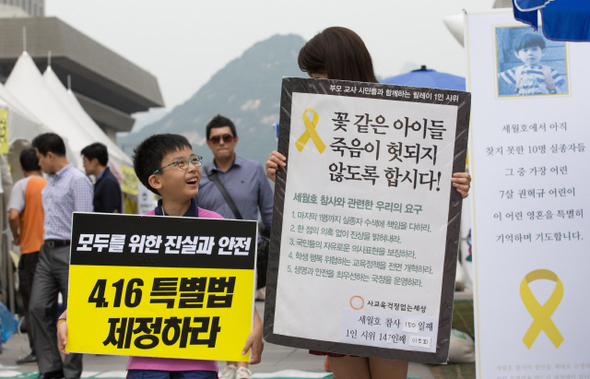
The Park Administration response to the Sewol sinking was absolutely inadequate. Protests and hunger strikes to demand accountability and preventative measures continue to grow five months after over 300 people, mostly students on a field trip, lost their lives.
A family assembles to demand a "safe world for my son."
Apparently some politicians demanding a transparent report on the Presidents' response have been gossiping and speculating on her sex life. Opposition lawmaker Sul Hoon referenced (and dismissed) rumors that President Park was engaging in a "tryst" during a 7 hour period during the tragic Sewol sinking.
President Park participates in mourning the deceased. 
“What did [President Park] do for those seven hours at the Blue House?” Sul asked. “I don’t think it’s true what people are saying about her having a tryst. I think that’s probably not it.”

The resulting political controversy has centered on demands that Sul resign and whether his words were intended to malign the President or to dismiss the rumors. Lost in this discussion is the sexism that the majority party is also leveling at President Park.

While Sul's accounting of the rumors demonstrate a sexist tendency to focus on the unmarried female President's leadership, they also highlight a sense of betrayal and mistrust. The gossip centers on what might have kept the President preoccupied specifically for the 7 hour period during the Sewol sinking.

On the other hand, Saenuri party spokesperson Park Dae-chul's statement blurs President Park's public office and private sex life, and are not limited to a discussion of the Sewol sinking, but extend to a general comment about women's sexuality:

“It’s troubling to think what might happen if there are rumors about ‘the President of the Republic of Korea having a tryst’ going around,” Park added. “The Saenuri Party intends to examine a possible complaint against Sul Hoon to the National Assembly Ethics Committee.”

What might happen?

By emphasizing the "Republic of Korea" in his statement, perhaps spokesman Park calls upon tried and tested fear of Korean womens' bodies and sexuality and the national image. He asks, how might Korea look to other nations?

Is the Saenuri Party particularly sensitive to North Korea state media describing President Park as a "crafty prostitute" in thrall to her "pimp" Barack Obama?" Or is Saenuri still unclear what they meant by the election campaign slogan "Prepared Woman President?" The party cultivates an image of a woman's body and sexuality sacrificed as the "mother of the Korean state" and in control in contrast to the womens' bodies the state aggressively polices and regulates.  

Campaign Slogan: Prepared Woman President


Sources:
Hankyoreh, Opposition lawmaker causes firestorm by referring to president’s “tryst”
Posted on : Sep.13,2014 14:15 KST  http://english.hani.co.kr/arti/english_edition/e_national/655017.html

9.06.2014

Pop Culture & Gender: Why Baekma?

Guest post by the band Baekma. KGC readers will know by now that I (Chelle) dislike the term Baekma,so I asked the band why they choose it and how they are using it to call attention to gender issues. Find the band on Facebook and listen to their music here. 

“What’s the name of your band?”  “Baekma.”  “Huh?” “BAEKMA!” 

The name we chose for our band warrants many types of responses.  Foreigners or Korean women must think we like galloping beautiful ponies when we explain the definition. Korean men, however, are left with looks of surprise, shock or comical amusement. These men almost always ask, “Do you know what that means?” as if we weren’t privy to their dirty little secret. Well, we do know what it means and we chose it to shock you, on purpose.

The phrase literally translates to ‘white horse’ taken from Chinese.  A Korean male friend informed me that it began a few decades ago as slang used to refer to the only Western women one could find in Korea, Russian prostitutes working the streets of Itaewon.  It evolved over time to mean any Western woman.  If this is the true origin, it’s no wonder that the word implies sex. Mumbled drunkenly among chingus when a wayguk woman passes them on the street at 4 am, or mentioned when a buddy returns from a vacation abroad, this word is tossed around between Korean men with curiosity: “What’s it like to ride the Baekma?” “Did you ride a Baekma on your trip to Europe?”

After Korean men realize we are aware of the negative connotations behind our name, we get responses like, “Why would you name your band that?” or “That’s so sexual!”
First off, I suppose we WANTED to be controversial and expose the stereotypes surrounding Western women. We started as an all-girl Western band, coming together after mixed experiences playing in bands with all boys. Besides feeling like we had more to prove since we were women in the music scene, we wanted to confront and challenge the idea that Western women are easy to get into bed or are only valuable in a sexual way. Just because a woman is in charge of her own sexuality, doesn’t mean she is promiscuous or dirty. Just because she has a nice set of legs or arms, doesn’t mean her wish in life is to use them to please a man. Just because she prefers to decide how she wants to look or act regardless of how a man says she should, doesn’t mean she is less beautiful. It’s easy to get disheartened in Korea if you do not fall into the limited impossible standard of beauty. We believe women shouldn’t be seen as less talented, less driven, less intelligent, or weaker than a man because cowardly men prefer it. It’s easy to get disheartened in Korea if you are not used to or do not fall into the very narrow ideal of feminine beauty within this culture. This standard is impossible to uphold without expensive treatments, surgery and/or hours wasted on grooming. Also, many men seem to be holding on the antiquated idea that women’s role in life is to serve them. Sam Hammington, whether speaking from his own mind, or instructed by a producer, said on the Global episode of Happy Together in 2013 that he married a Korean woman because “Korean women are really good to men,” implying that Western women are NOT because they “have their own lives”, “are never affectionate” and “never act cute”. In one quick comment, he reduced Korean women’s existence and demonized the concept of independent women in charge of their own lives. We know that Korean women are tired of their stereotypes and expectations as much as we are. We channeled our frustrations of living in this hyper-sexualized and misogynist society into our music.

There hasn’t really been anyone providing a voice for the foreign women community within the indie rock scene in Seoul. We feel we have a unique perspective on gender issues as we compare progress here and abroad. We hope our voices can support the movement towards gender equality and freedom of women to choose what they want to become not only in Korea, but also worldwide.

So we are BaekMas. We are not offended by that word. We are Baekmas. We act and dress how we want. We say what we feel and believe in. We write songs about the shitty stuff we see happening to people around us that’s sometimes based on gender. We sing about how we want the world to be. We will probably disagree with you. We may even piss you off. We may or may not sleep with you. But we will definitely make sweet love to your ear holes with our synth dance pop rock.

Find information on Baekma's upcoming podcast here.


5.14.2014

Attend my talk on Korea's Sex Trafficking Prevention Act, International Norms & Local Legal Rhetoric

I will present a part of my research this Friday afternoon at the International Studies Academic Conference hosted by Yonsei University. The event will run from 1PM to 6PM in New Millenium Hall Room 101. I think I may be the last speaker on the second panel in the flyer below (after 3:30PM presumably). Just FYI, venue is located closer to the Ehwa University back entrance bus stop although you can enjoy the walk through the campus from the Yonsei front gate if you'd like. Hope to see some familiar faces in the audience~


1.25.2014

Street Harassment in Korea

A little over six weeks since launching Hollaback! Korea I have already read about 20 stories from members of our community. I have also seen hundreds of people step up to join our project to end street harassment. At our events and during interviews, a number of people who have not written their stories and shared to the site have also discussed the issue with me.

An audience member at our Bystander Intervention Workshop
I am frequently asked, "What is Hollaback?"

Hollaback is an international movement to end street harassment that is active in 24 countries and over 71 cities in 10 languages. By street harassment, we refer to sexist, racist, transphobic, homophobic, ableist, sizeist and/or classist harassment that often targets women, LGBTQ and transgender community members. This harassment takes place in public places like parks, the subway, on the street or in a shop. Street harassment can be intimidating behavior intended to make the target uncomfortable or scared. It can be verbal, physical, gestures or noises, and other forms of intimidating behavior.

"How was Hollaback! Korea founded?"

We are organizing this project all over Korea, but particularly in Seoul, Gwangju, Jeju, Seosan, Daejeon and Daegu. I started to recruit founding team members last July and we all participated in a 3 month online training course and supported by the iHollaback international team so that we could prepare for the launch in early December. We had a lot of hard work like translating the website and mobile app into English, planning 5 launch events in Seoul, Gwangju and Jeju, moderating and growing our social media presence on Facebook and Twitter, and doing media and press outreach. I am really grateful to our team for their dedication and to our community for their warm welcome.

"How does Hollaback! address street harassment?"

Hollaback! has empowered people in over 70 cities and 24 countries internationally to respond to street harassment through a smartphone or web application. Users are encouraged to speak up when they see harassment by quickly documenting it in a short post (photo optional) and sharing it to a publicly viewable map. Anyone browsing the stories on the Hollaback! maps immediately understands 3 things:

1) If you’ve been harassed, you’re not alone,
2) Street harassment is used to exert control over others by making them feel scared or uncomfortable. It is much more than individuals just acting inappropriately.
3) There are street harassment “hotspots” in most cities often centered around high pedestrian traffic areas.
Hollaback! provides comfort to those harassed, and proof that street harassment is a serious problem warranting a serious response from policy makers.

"Is Hollaback! Korea different from other sites because of domestic law?"  

First, it is important to note that our project is about support and social awareness. We are primarily focused on supporting those targeted for street harassment and to promoting public outreach to stop harassers. We believe that what specifically counts as street harassment is determined by those who experience it.  If you’ve experienced street harassment, we’ve got your back! I highly recommend speaking with an organization like Korea Womens Hotline for more detailed analysis of the law, but I can make some personal observations about Korea law.

I think that the Korean legal system is one of the most well organized in the world. Of course there are differences in legal codes country to country, for example, some countries recognize a Good Samaritan code more than Korea. This means that if you intervene to protect someone in danger you get some consideration for being a Good Samaritan. A major difference might be that although Hollaback users in New York and other cities can post the face of their harasser, on our site we have to blur the face and the names of any businesses in the image. We can, and do, post images, but the face has to be blurred. Some countries have more extensive laws covering street harassment than Korea and some do not have such laws. Right now there is a public indecency law with a fine of 30,000 won on the books.

Learn more

I was recently invited to TBS eFM for an interview about Hollaback! Korea to discuss street harassment and have shared the interview below.
10.01.2013

Extended Rebuttal: Inflated Assumption that Sex Workers in Korea Earn “higher than the average Korean”

Here at Korea Gender Café we attempt to present information, data and translations that add to discussion of gender issues in Korean society because we hope to spur discussion. 

Yesterday we submitted a rebuttal piece to koreaBANG’stranslation “Disbelief as Korea is Ranked 108th in Global Gender Equality” that broke down a few methodological flaws in Dr. Kang’s data analysis. Due to space constraints we were unable to respond point-by-point to many of his opinionated assertions. In this post we’d like to zero in on one of the problematic opinions and attitudes he brought into the debate about gender inequality: that the exclusion of the sex industry from workforce participation data inflates the inequality between men and women.

Kang writes,
“Does the misinterpreted data about socioeconomic discrimination in fact imply discrimination against men? 
There are also many problems with the data commonly used to claim sexualdiscrimination against women within Korea. The popular story is that women arebeing discriminated against, as shown by the big gender gap in employment rateand income. However, we need to take a closer look. In fact, the gender gap in employment rate and income is exaggerated in Korea.Among OECD countries, only Korea and Slovenia have made the sex trade completely illegal. MOGEF estimated that there might be 140~270k or a higher number of female sex workers in Korea. Sex workers who earn more than the average worker are exempted from the Korean income statistics while othercountries include them. This partly contributes to the income gap that appearswider on paper than it really is. 
Do they turn a blind eye to this for the sexual discrimination claims?” 
In our submission to koreaBANG we began to respond:
“Dr.Kang points out human rights violations against women in other countries, butwe can point to sexual violence and human rights violations in every country.That is not the purpose of these indices. We agree that it is problematic thatgender inequality indexes do not adequately reflect violence against women orsexual violence. We disagree with Dr. Kang’s outward looking criticism andencourage discussion of sexual violence in Korea.” 
To elaborate, if we want to discuss human rights violations in South Korea, we could pay close attention to the upcoming Constitution Court ruling on the 2004 Act to Prevent Sex Trafficking and Prohibit Prostitution.

First, sex work is omitted from income statistics, as is drug trade, gang/mafia membership and other illegal industries in which we may find both women and men employed. Rather than claiming that its exclusion is an conspiracy to "turn a blind eye" and that it implies "discrimination against men" we find this to be a more persuasive explanation. 

Second, this assumption that sex work earns high incomes likely ignores workplace conditions, rental fees, the lack of pension, income inconsistencies, associated costs, and may obscure all those that profit from the work by taking a portion of fees, etc. 

Third, Dr. Kang does not tell us how many men are employed as sex workers, but some could argue that purchasing the right to sexual use of another’s body in a sex industry with “140~270k or a higher number of female sex workers” in and of itself could be indicative of gender inequality. If the working population is that high while the working population is low in other industries, it suggests there is a segregation of women into a few industries.  

Fourth, others could argue that Dr. Kang ignores men employed in the sex industry or who act as employers of female sex workers. Meanwhile MBN News contributes a stigmatizing tone toward LGBTQ sex workers. 

But what we would really like to argue about -- and the reason we highly anticipate the above mentioned Constitutional Court ruling -- is the persistent social stigmatization of sex workers and violation of sex worker's human rights in police crackdown and incarceration.

First, Dr. Kang never mentions that male clients are only sometimes sent to “John school” while female sex workers pay steep fines and face up to 2 years of mandatory re-education or prison. This is one more example of gender inequality in sentencing. Dr. Kang doesn’t highlight those aspects of policy that actually exist, and he presents no evidence to support his assertions.

Second, sex workers in Korea report serious human rights violations as a consequence of the current legal regime. Sex workers report swallowing condoms because simply walking with a condom is used by the police as evidence against a sex worker. The safety and health implications are rather obvious, but we urge you to read the UNDP report "Sex Work and the Law in Asia and the Pacific: Laws, HIV and human rights in the context of sex work."[1]

Third, heavy stigmatization of females in the sex industry means that even if there were not criminal penalties, gender inequality in sentencing and health perils associated with an aggressive police crackdown, workers are marginalized socially. We highly recommend Katherine Moon’s research for further reading on the history of segregated sex workers near military bases.[2] 

My ongoing research examines the relationship between the 2004 law, court sentencing and gender in Korean society. In the coming months and after publication, I look forward to sharing additional information with our readers. In the meantime, we highly recommend reading posts by sex worker’s rights NGO Giant Girls, 성노동 이론 봇 and Research Project Korea for news. 


For further reading:

Giant Girls, Grant Application, Global Fund for Women, 2010. https://grants.globalfundforwomen.org/GFWSearch/index.php?id=30551

한상희, 건국대 교수, 헌법. “성매매방지법과 여성인권” 민주법학 제30호, 2006.

최우리 기자, "당신이 굳게 믿는 그것이 진리일까," 한겨레,  2012.12.01. http://media.daum.net/society/newsview?newsid=20121201111004557

Cheng, Sealing. “Rethinking “Human Trafficking”: Reflections from South Korea” in Woodrow Wilson International Center for Scholars, MIDDLE EAST PROGRAM & UNITED STATES STUDIES, OCCASIONAL PAPER SERIES, Rethinking Human “Trafficking,” SUMMER 2010.

Godwin, John. "Sex Work and the Law in Asia and the Pacific: Laws, HIV and human rights in the context of sex work." United Nations Development Programme, Oct 2012, p. 112. http://asia-pacific.undp.org/

Kim, Ji Hye. Korea’s New Prostitution Policy: Overcoming Challenges to Effectuate the Legislature’s Intent to Protect Prostitutes from Abuse. Pacific Rim Law & Policy Journal Association, 2007

Moon, Katherine. Military Prostitution and the U.S. Military in Asia, The Asia-Pacific Journal; Japan Focus, Jan 17, 2009.

Weiss, Ayla. Ten Years of Fighting Trafficking: Critiquing the Trafficking in Persons Report through the Case of South Korea, Asian-Pacific Law & Policy Journal [Vol. 13:2, 2012].


[1] Godwin, John. "Sex Work and the Law in Asia and the Pacific: Laws, HIV and human rights in the context of sex work." United Nations Development Programme, Oct 2012, p. 112. http://asia-pacific.undp.org/
[2] Moon, Katherine. Military Prostitution and the U.S. Military in Asia, The Asia-Pacific Journal; Japan Focus, Jan 17, 2009.

9.17.2013

CHEWSOCK Film Fest, Sept. 18-19 at Art Nine in Seoul, Korean Films English Subtitles

Looking for Korean films with English subtitles to watch this Chuseok holiday? 
Check out these Korean films screening with English subtitles at ArtNine (12Flr, Megabox building: Line 4 Chongshin Univ Station, Line 7 Isu Station, about a 10 minute walk from Line 2 Sadang Station via exit 10).

Make reservations in English at Cine In Korea with an easy bank transfer

Here are screen grabs of the brochure with descriptions of a few of the films that might interest our readers (or at least I think they sound interesting... better not sell out before I get my tickets!):


Please see the programs below for more information:


9.18 (Wed)  CULTURAL EVENTS
TIME
EVENT
TIME
EVENT
15:30
Pansori Performance (HWANG Eri)
11:00 ~ 18:00
-Traditional Korean Games
-Make traditional crafts
-Learn to set up a Chuseok meal
17:00
Gugak Performance
(National Gugak Orchestra members)
18:00
Opening Ceremony + Reception (Invited guests, sponsors, package pass holders)

9.19 (Thu)  CULTURAL EVENTS
TIME
EVENT
TIME
EVENT
12:00~
13:00
Chuseok Lunch
(Chuseok Film Festival ticket-holders only)
10:00 ~ 17:00
Chuseok Flea Market
18:00
Traditional Games Contest (with prizes)
10:00 ~ 18:00
-Traditional Korean Games
-Make traditional crafts
-Learn to set up a Chuseok meal
19:30
Fusion Gugak Performance (Namyeoul)
20:00
Award Ceremony
22:00
Closing Party (Itaewon)

9.18 (수)  문화 행사
시간
행사
시간
행사
15:30
판소리 공연 (황애리)
11:00 ~ 18:00
-민속놀이
-전통 공예품 만들기
-차례상 차리는 법 배우기
17:00
국립국악관현악단원 공연
18:00
개막식 및 리셉션 (초대장 소지자에 한함)

9.19 (목)  문화 행사
시간
행사
시간
행사
12:00~
    13:00
추석 점심
(추석영상기획전 표 소지자에 한함)
10:00 ~   
  17:00
추석장터
18:00
민속놀이 대회 (경품)
11:00 ~
  18:00
-민속놀이
-전통 공예품 만들기
-차례상 차리는 법 배우기
19:30
퓨전 국악 공연 (남.여.울)
20:00
시상식
22:00
폐막 파티 (이태원)
9월 18일 15:30 공연
황애리(소리꾼) HWANG Ae-ri(Pansori Singer)
중앙대 국악대 음악극과를 졸업한 소리꾼 황애리는 전통 판소리뿐만 아니라 프리뮤직, 가요 등을 비롯한 각종 예술 프로젝트에 참여하며 다방면에 걸친 활동을 해왔다. 2008년 제35회 춘향국악대전 일반부 판소리부문 대상을 수상한 바 있으며 이태원프로젝트 “판소리에듀케이션” 워크샵을 진행하였고 하찌와 애리, 우리소리 바라지의 멤버로 활동해왔다.
2008년 제35회 춘향국악대전 판소리 일반부 대상
2003년 땅끝해남 전국국악경연대회 민요부분 금상


9월 18일 17:00 공연
국립국악관련악단원


문형희 대금수석
-중앙대 음악대학 한국음악과졸업중요무형문화재 제45호 이수자국립국악관현악단, 성남시립국악관현악단 외 다수 협연서울국악예고 강사역임중앙대학교 출강현) 국립국악관현악단 부수석
수상경력
09년 문화부장관상 표창
안수련 해금수석
-중앙대 음악대학 한국음악과 졸업-중앙국악관현악단 단원 역임-서울 국악예고 강사 역임국립국악관현악단, 중앙국악관현악단, 대구시립국악단, 코리안심포니오케스트라 협연 외 다수인천시립무용단 20주년 기념 초청 연주 협연일본 아이치 박람회 한국대표 한,중,일 실내악 합동 연주베트남 하노이 초청연주회 협연“소리 숲을 걷다” 해금독주회해금퓨전음반 1집~4집현) 국립국악관현악단 단원
수상경력: 제33회 전국 난계 국악경연대회 일반부 대통령상
문양숙 가야금수석
95년 국립국악관현악단 22현가야금 지도98년 국립국악관현악단 입단국내 및 해외 독주회 5회국립국악관현악단 외 다수 협연국립전통예술고등학교, 중앙대학교, 목원대학교 강사역임영남대학교, 목원대학교 겸임교수역임01~03년 여성국악실내악단 “다스름”단원역임현) 서울대학교 출강숙명 글로리아 가야금 앙상블 연주 트레이너국립국악관현악단 부수석
이승호 타악
국립국악관현악단, 중앙국악관현현악단 외 다수협연민속악회수리 악장 역임
임교민 신디사이져 협연 출연자
그룹 수풀림 멤버


9월 19일 19:30 공연: 남.여.울

창작음악그룹 <남.여.울>은 “남자 여럿 울린” 때론 “남자때문에 여러 번 울기도 하는” 음악하는 여자들이 만나 만든 밴드이다.
봄타듯, 가을타듯, 음악타는 여자들<남.여.울>은 조해인(작곡,건반,바이올린), 박경진(타악/소리), 박미은(피리/태평소/장새납),이송이(가야금)을 주축으로 2010년 창단하여 창작음악과 전통음악 재창작 작업을 꾸준히 이어나가고 있다.
이들은 장르의 형식에 구애받지 않고 전통음악, 현대음악, 포크, 모던 락, 클래식에 이르기까지 예술가와 관객의 관계를 깊게 고민하며 '감정에 충실한' 달콤하면서 때로는 쌉사름한 창작음악을 선보인다

연주자: 조해인(건반,바이올린)
박미은(피리,태평소,장새납)
김애리(가야금, 보컬)


9.07.2013

Slut-shaming the Parent Hurts the Child: Chief Prosecutor Chae Dong-wook, the Blue House and Korean Media

Slut-shaming the Parent Hurts the Child: 
Chief Prosecutor Chae Dong-wook, the Blue House and Korean Media

TODAY the Joongang Daily brought us “Love child report roils prosecutors, Blue House.” 

THE media knows very little about this case, and I know even less. Chief Prosecutor Chae Dong-wook may have a 10-year-old child outside of marriage. The second point of speculation centers on whether or not Chae paid for housing for his alleged son:
“In his confirmation hearing, Chae reported that his assets amounted to 1.25 billion won ($1.14 million), which included a 32-pyeong (1,138.7 square feet) apartment worth 654 million won in Irwon-dong, southern Seoul and 440 million won in savings. 
If the alleged son’s housing was paid for by Chae, he made a false report about his assets.
Chae rented out the apartment and currently lives in a nearby apartment with his wife and a daughter, having paid jeonse, or a lump-sum deposit, in lieu of rent. The jeonse was 450 million won."

HERE is where it gets really ugly:

“One of the reasons the Blue House named Chae as prosecution chief was because he was considered relatively clean in terms of financial background and also hadn’t dodged the draft.
“We never knew about this,” a spokesman of the Blue House told the JoongAng Ilbo. “If we knew about this, how could we possibly have appointed Chae as the prosecution chief?”
But there is contrary speculation that the Blue House, National Intelligence Service and officials of the ruling party were aware of Chae’s personal background, and details have now been leaked by a group that doesn’t want him leading the prosecution anymore.”

IN saying “If we knew about this, how could we possibly have appointed Chae?” The Blue House Spokesman does not seem to be referring to the false report of his assets in April. In that case, the Blue House Spokesman could say something like “We are deeply regretful that Chae has betrayed the public trust by not fully disclosing this information about his asset holdings.” It seems far more likely that the Blue House Spokesman is talking about Chae having a child out-of-wedlock.

ONCE again, the media knows very little about this case, and I know even less.  What I do know is that less than 13% of men in Korea pay child support to the unwed mothers who care for their children.[1]  So here we have Chae, who is providing for his son – in a social context of extreme stigmatization against children born to unwed mothers – being heavily criticized not so much for failing to come clean about his financial background, but is being attacked because “of Chae’s personal background.” 

SO, what message does this send to the 87% of men who father children out-of-wedlock? Definitely not to come clean and take responsibility for their children by paying for child support. If an unwed father did that, then the Blue House would know about his "personal background" and how could they ever appoint him to a high position or promote him? By slut-shaming either mother and father, Korean society, the media and now the Blue House show disregard for the human rights of children born out to unmarried parents. This attitude permits discrimination against children, denies them the right to support and care, and sends a broad social message that condemns their birth. 

THIS pervasive attitude may be tied to Korea’s repeated critique at UN committee hearings for Korea’s failure to adhere to the Convention on the Rights of the Child (CRC). The stigmatization of children and their unwed parents is tied to socio-economic consequences that deny these children equal opportunity under the law. Back in 2003 UN CRC concluding observations started to call attention to the fact that Korea insufficiently addresses “development of public education campaigns to combat discriminatory attitudes towards girls, disabled children and children born out of wedlock” and also expressed concern over the “limited amount of information regarding acts of discrimination against children from single parent families, children born out of wedlock, children with disabilities.  It is also concerned that the Constitution does not explicitly prohibit discrimination on the grounds of factors including disability, birth or other status, as stated in the Convention.”[2]  We also urge readers to take a look at our Korean Gender Café discussion on the stigmatization of unwed mothers and their children to find links to additional reports, summary of important data and interviews with unwed parents.  

FINALLY, let’s also talk about hyperbolic writing. The article opens “The criminal justice system was thrown into confusion early yesterday by a news report that disclosed an out-of-wedlock son of chief prosecutor Chae Dong-wook in the middle of a high-profile insurrection case and charges that the nation’s spy agency interfered in last year’s presidential election.” Really? Was the criminal justice system was thrown into confusion by the news of an out-of-wedlock son, or by the charge of corruption and insurrection by the nation’s leaders? The latter issues are far more threatening to the criminal justice system than an out-of-wedlock birth.

I WISH the justice system WERE thrown into confusion by a child born out-of-wedlock … maybe in that case the legal system would actually hold parents accountable for child support, protect the best interests of a child by keeping them with their family members, and promote healthy acceptance of all families, thereby promoting children’s equal rights and safe access to shelter, love, healthcare and education.


[1] According to KUMSN and KWDI, 56.8%  of unwed mothers earned less than 1 million, 23% earned 1-1.5 million won, and only 20.2% had a monthly income of more than 2 million won per month. Only 14.6% of unwed mothers were receiving child support. Only 12.7% of divorced parents received child support from their ex-spouses. Source: Strengthening the Responsibility of Unwed Fatherhood, KUMSN & KWDI Conference, 2013.